

If your business collects debts in California and you’ve never had to think about consumer protection law before, that’s about to change. As of this year, some of your everyday commercial transactions are now playing by consumer rules.
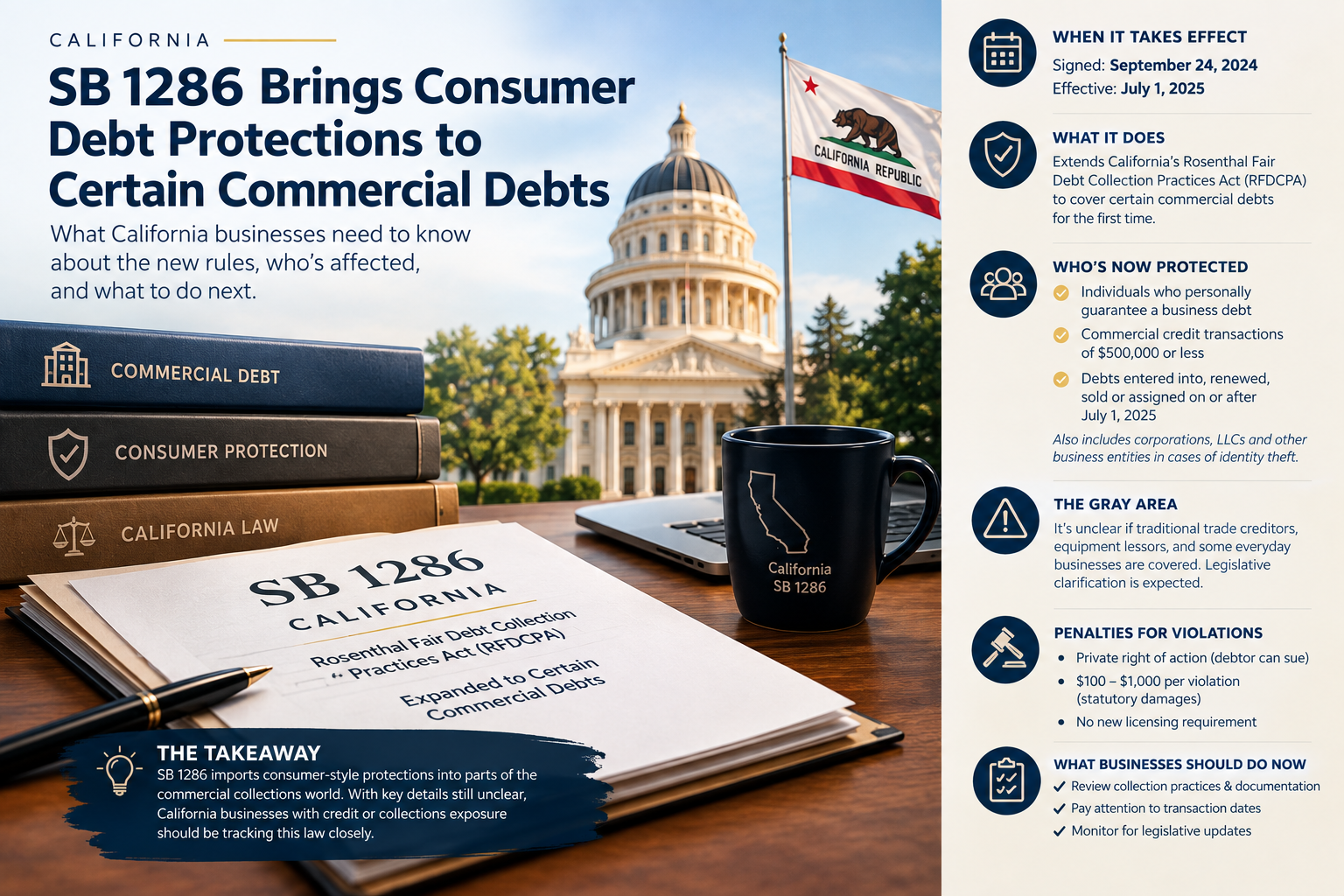
California’s Senate Bill 1286 officially took effect on July 1, 2025, extending key protections from the state’s Rosenthal Fair Debt Collection Practices Act (RFDCPA) — previously limited to personal, consumer-level debt — to cover certain commercial debts for the first time. For credit professionals and lenders who’ve spent years treating business debt collection as fundamentally different from consumer collection, this is a meaningful shift in the ground rules.
What SB 1286 Actually Does
Governor Gavin Newsom signed SB 1286 into law on September 24, 2024, amending California’s Rosenthal Fair Debt Collection Practices Act. To understand why this matters, it helps to know how the RFDCPA differs from its federal counterpart, the Fair Debt Collection Practices Act (FDCPA).
The federal FDCPA generally only applies to third-party debt collectors — companies collecting debt on someone else’s behalf. California’s Rosenthal Act goes further, applying to creditors collecting their own debts under their own name, as well as third-party collectors and attorneys collecting on behalf of others. That broader reach is exactly why SB 1286’s expansion matters so much to California businesses: it doesn’t just affect specialized collection agencies, it affects ordinary companies collecting on their own unpaid invoices and accounts.
Who’s Newly Protected
Before this change, business debt was essentially outside the scope of the Rosenthal Act entirely. SB 1286 changes that by creating a new category called “covered debt,” which now includes certain commercial obligations alongside traditional consumer debt.
Specifically, the law extends new protections to:
- Individuals who’ve personally guaranteed a business debt — a common arrangement for small business owners and sole proprietors who back company borrowing with their own personal liability
- Commercial credit transactions valued at $500,000 or less, based on the total value acquired on credit for purposes other than personal, family, or household use
- Debts that are entered into, renewed, sold, or assigned on or after July 1, 2025 — meaning older, pre-existing commercial debts generally fall outside the new rules
Notably, the protections aren’t limited only to individual people. According to Chris Ng, managing partner at law firm Gibbs Giden Locher Turner Senet & Wittbrodt LLP, SB 1286 also extends specifically to corporations, limited liability companies, and other business entities in cases involving identity theft claims — even though most of the bill’s other provisions are aimed at individuals like sole proprietors and personal guarantors.
A Real Gray Area: Who Exactly Has to Comply?
Here’s where things get genuinely uncertain, and it’s worth flagging clearly rather than glossing over. SB 1286’s obligations are written to apply to three specific categories: lenders, commercial financing providers, and debt collectors. But many everyday businesses that extend credit don’t neatly fit into any of those three buckets.
Take a typical trade creditor — a business that sells goods or leases equipment on short-term credit terms as part of an ordinary commercial relationship. According to legal analysis of the bill, it’s genuinely unclear whether these businesses fall under SB 1286’s new requirements at all, since they aren’t traditional lenders, financing companies, or collection agencies in the conventional sense.
Ng has been direct about this ambiguity, noting that his firm continues to approach SB 1286 cautiously, while actively working on legislative efforts aimed at securing clearer language that would explicitly exclude trade creditors and equipment lessors from the law’s scope.
What Happens If a Business Gets It Wrong
SB 1286 doesn’t create a new, separate penalty system — it simply extends the Rosenthal Act’s existing enforcement mechanism to this newly covered commercial debt. That means the same consequences that have always applied to consumer debt violations now apply to qualifying commercial debt violations too:
- Affected debtors gain a private right of action, meaning they can sue directly over violations rather than relying solely on a regulator to act
- Statutory damages range from $100 to $1,000 per violation, separate from any actual financial harm the debtor may have suffered
- The law does not create any new licensing requirement under California’s separate Debt Collection Licensing Act — SB 1286 explicitly clarifies that point
For businesses used to routine, informal commercial collection practices, this shift meaningfully raises the legal stakes of getting the process wrong, even in transactions that might have felt like standard business-to-business dealings just a year ago.
What California Businesses Should Do Now
Given the genuine ambiguity still surrounding parts of this law, credit professionals with California customers or commercial debt portfolios have a few practical steps worth taking:
- Review existing collection practices and documentation procedures against Rosenthal Act requirements, since commercial debt collection may now trigger the same disclosure and conduct obligations long required for consumer debt
- Pay close attention to transaction dates. Since SB 1286 only applies to commercial debts entered into, renewed, sold, or assigned on or after July 1, 2025, older accounts may not be affected the same way
- Watch for legislative clarification. Because the applicability question for traditional trade creditors remains genuinely unsettled, businesses in that gray area should stay alert for amendments or regulatory guidance that could narrow or confirm the law’s reach
The Take Away
SB 1286 represents one of the more significant shifts in California credit and collections law in recent years, effectively importing consumer-style protections into parts of the commercial lending and collections world for the first time. With real ambiguity still unresolved around exactly who the law covers, and active efforts underway to clarify its boundaries, this is a law credit professionals with California exposure should be tracking closely rather than assuming it doesn’t apply to them.
Source:
This post is based on NACM’s Business Credit Magazine coverage of California Senate Bill 1286, along with the bill’s official text and legislative history from the California State Legislature. It is cross-referenced against legal analysis published by several law firms tracking the bill’s rollout, including Womble Bond Dickinson, Snell & Wilmer, Buchalter, and Rounds & Sutter, to confirm dates, statutory language, and the open compliance questions the law has raised for California businesses.