

Most companies that break the rules get fined. A much smaller group gets something far more permanent: a federal court order banning them from the debt collection industry entirely, for life.
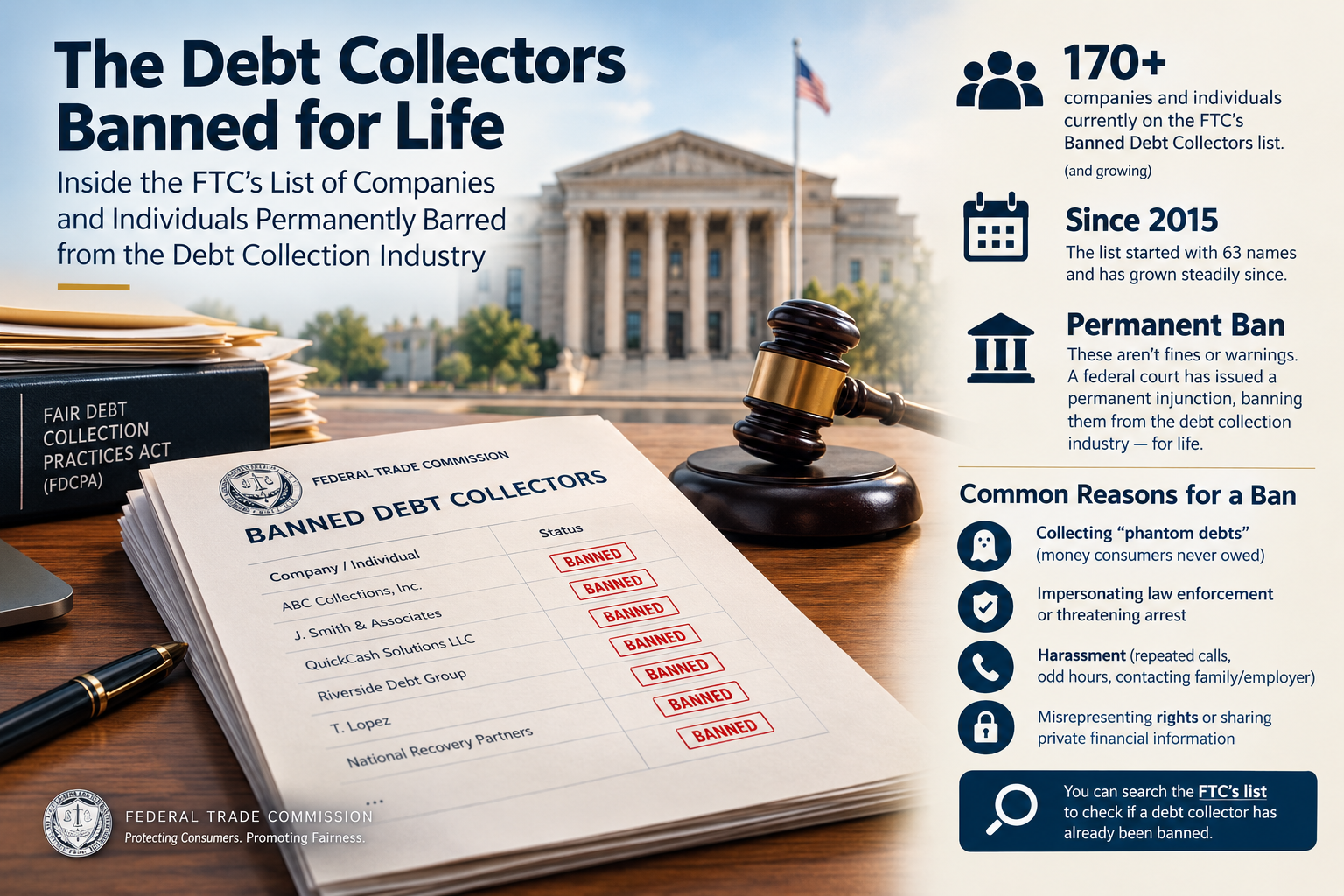
The Federal Trade Commission maintains a running public list, officially titled Banned Debt Collectors, naming every company and individual who has been permanently prohibited by federal court order from participating in the debt collection business. The list has grown steadily since it was first published, and today names more than 170 companies and individuals, spanning enforcement actions going back more than two decades.
What “Permanently Banned” Actually Means
It’s worth being precise about what this list represents, because the FTC’s own language is unusually blunt about it. Being named on this list isn’t the same as receiving a fine or a warning letter. It means a federal court has issued a permanent injunction — a binding legal order — prohibiting that specific company or person from ever working in debt collection again, under any name.
The FTC itself has described the practical effect of these bans in plain terms: the companies are shut down, finished, and permanently barred, with the bans enforceable in court going forward. Unlike a fine, which a company can simply pay and continue operating, a ban is designed to end that party’s involvement in the industry entirely.
How a Company Ends Up on the List
Getting permanently banned isn’t the FTC’s first move — it’s typically reserved for the most serious, repeated, or deliberate violations of consumer protection law. According to the FTC and organizations that track these cases, the conduct that leads to a ban commonly includes:
- Attempting to collect “phantom debts” — money consumers never actually owed in the first place
- Impersonating law enforcement or threatening arrest, jail time, or legal action the collector has no actual authority to pursue
- Harassment, including repeated calls, calls at unreasonable hours, or contacting a consumer’s employer or family members inappropriately
- Misrepresenting a consumer’s legal rights, or disclosing private financial information to third parties without authorization
These practices generally violate the Fair Debt Collection Practices Act (FDCPA), the primary federal law governing how debt collectors are allowed to operate. When violations are severe or repeated enough, the FTC pursues a federal lawsuit specifically seeking a permanent ban, rather than a financial settlement alone.
The List Has Grown Significantly Over Time
The FTC first published this list publicly in February 2015, starting with 63 banned entities. Later that same year, the number had already grown past 100, driven largely by a coordinated federal-state enforcement effort called Operation Collection Protection, the first initiative of its kind specifically targeting deceptive and abusive debt collection practices nationwide.
By the end of 2016, the FTC reported the list had reached 139 individuals and companies. Since then, the list has continued expanding with new enforcement actions added regularly, and current tracking places the total at more than 170 names — though because the FTC updates the list on an ongoing basis, the exact figure at any given moment is best checked directly on the agency’s own page.
Why the Same Names Keep Showing Up in Clusters
One pattern worth understanding if you’re reviewing this list: many entries aren’t standalone companies. A single enforcement case often results in several related entities and individuals being banned together, because operators frequently ran multiple shell companies, doing-business-as names, or affiliated LLCs as part of the same underlying scheme. It’s common to see one FTC case link to five, ten, or more names on the list at once — reflecting how these operations were often structured to make a shut-down company easy to quietly relaunch under a new name, until the ban specifically closes that loophole too.
How to Actually Use This List
The FTC’s list is organized as a searchable reference, with each banned entity linked to two things: the underlying legal case (including press releases and the original complaint) and the actual court order that put the ban in place. This structure makes it possible to verify, for any specific company name, whether it has been formally and permanently banned — useful for consumers who want to check whether a collector contacting them has already been shut down by federal court order, and for legitimate industry players doing due diligence on a potential partner or contractor.
If you’re contacted by a debt collector and want to check their standing, cross-referencing the name against this list, along with your state’s own regulatory actions, is a reasonable first step before making any payment or providing personal financial information.
The Take Away
A fine tells a company it did something wrong. A permanent ban tells them — and everyone else — that the conduct was serious enough to end their ability to operate in the industry at all. With more than 170 names now on the FTC’s list and new entries added as enforcement actions conclude, it stands as one of the clearer public records of where the line sits between aggressive collection practices and outright illegal ones.
Source:
This post is based on the Federal Trade Commission’s official Banned Debt Collectors list and related FTC enforcement pages, which name the companies and individuals permanently barred by federal court order from the debt collection industry. Historical figures on the list’s growth are drawn from the FTC’s own business guidance blog and from Military Consumer, an FTC-run consumer education site, and are cross-referenced against independent industry reporting from insideARM. Because the FTC updates the underlying list on an ongoing basis, readers should treat the current total cited here as an approximation and consult the FTC’s page directly for the live, complete roster.