


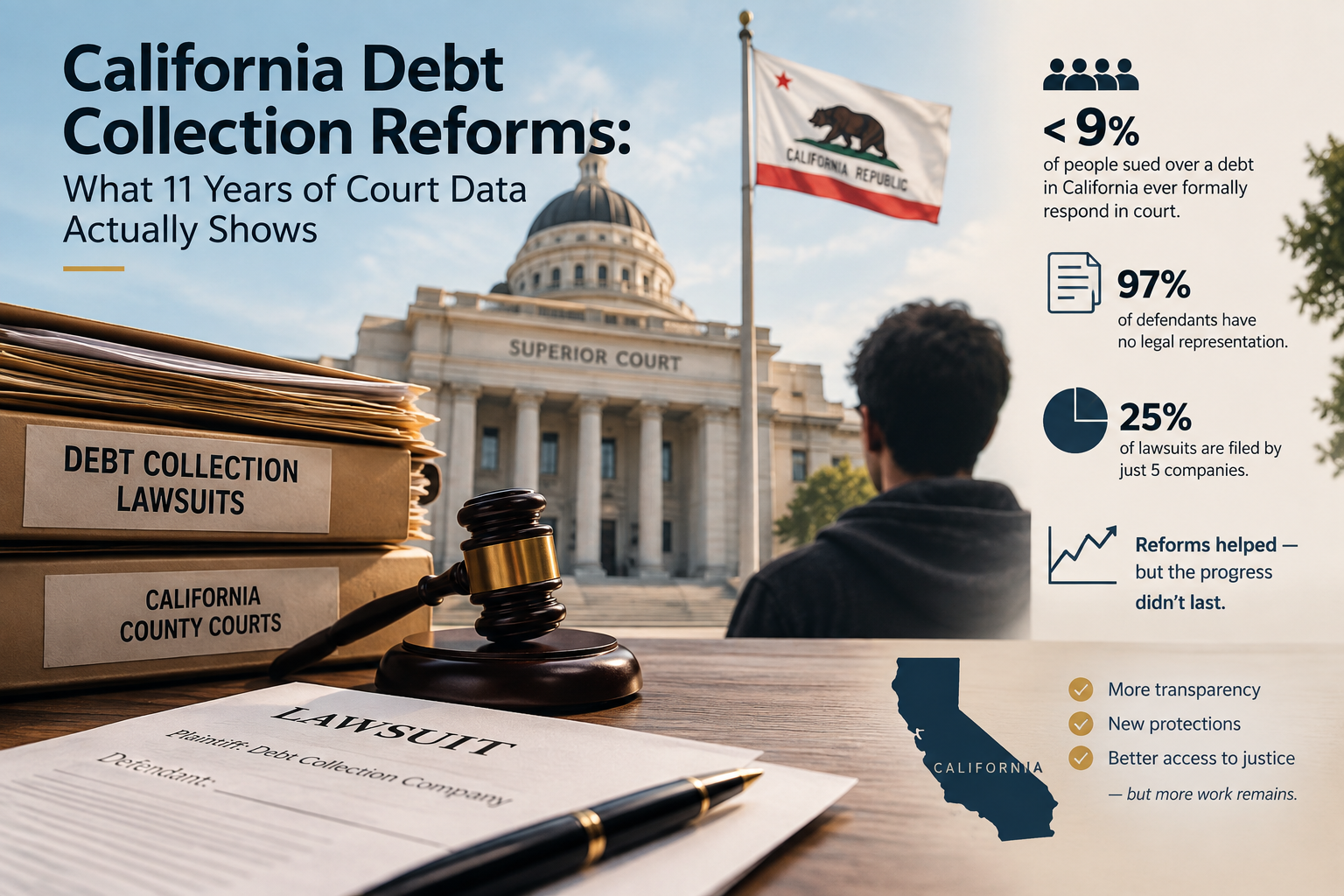
Here’s a number worth sitting with: out of every 100 people sued over a debt in California, fewer than 9 ever formally respond in court. Not because they don’t owe the money or don’t have a defense — often, they simply never engage with the case at all. A new data-driven study set out to figure out whether California’s reform efforts have actually changed that picture, and the answer turns out to be: yes, somewhat, but not nearly enough.
Researchers at Princeton University’s Debt Collection Lab — including lead researcher Claire Johnson Raba, an assistant professor who previously taught at UC Irvine’s law school — working with data analysts at the University of California, Irvine, examined 11 years of California state court records to measure whether state and federal reforms enacted in the early 2010s have actually reduced how one-sided debt collection lawsuits tend to be. The findings paint a mixed picture: real, measurable progress on paper, paired with a court system that still overwhelmingly favors whoever files the lawsuit.
The Scope of the Study
This wasn’t a small sample. The research covered court records from 16 California counties, together home to roughly 80% of the state’s population, spanning cases filed between 2009 and 2020. That scale makes it one of the more comprehensive looks at how debt collection lawsuits actually play out inside a state court system, rather than relying on anecdotes or a handful of case studies.
What Changed After the Reforms
To understand what the study measured, it helps to know what changed and when. In 2010, the federal government created the Consumer Financial Protection Bureau (CFPB), giving it authority to enforce the Fair Debt Collection Practices Act, a federal law setting baseline standards for how debt collectors are allowed to operate.
California followed with its own state-level law in 2013: the Fair Debt Buying Practices Act (FDBPA). This law required debt collectors to actually provide documentation backing up their claims, both to the court and to the person being sued, rather than simply asserting a debt was owed. The idea was straightforward: make it harder to file weak or unsupported claims, and reduce the number of cases where a defendant loses automatically simply because they never showed up.
According to the study, these reforms did correlate with a real, measurable effect. Following the FDBPA’s introduction, California saw both a decline in the overall number of debt collection lawsuits filed and a drop in the rate of default judgments — cases won automatically because the defendant didn’t respond.
The Improvement Didn’t Last
Here’s the part that complicates the good news: that early decline wasn’t permanent. According to the study, debt collection lawsuit filings in California rose again significantly in 2018 and 2019 — the two years immediately before the COVID-19 pandemic — essentially undoing some of the earlier progress.
This detail matters for anyone tracking whether reforms actually stick over time. A law passed once doesn’t guarantee lasting change; it requires ongoing attention from courts, regulators, and lawmakers to keep working as intended.
The Bigger Problem: Almost Nobody Shows Up to Defend Themselves
Even with the reforms in place, the study uncovered a deeper, more persistent issue: most people being sued over debt in California never meaningfully participate in their own case.
Looking at cases filed between 2009 and 2020, researchers found that fewer than 9% of defendants ever formally engaged with their lawsuit in any way. More specifically, only 8.8% filed a formal answer — the specific legal step required under California law to avoid an automatic default judgment against you.
The consequences of not responding are significant. Once a default judgment is entered, debt collectors can pursue wage garnishment or freeze funds in a defendant’s bank account. California law does protect some income and bank funds from garnishment, but that protection isn’t automatic in most cases — defendants have to actively file an exemption claim in court to receive it. The study found that only 3% of defendants who were subject to garnishment during the study period actually filed that exemption claim.
The data also shows just how much responding to a lawsuit changes the outcome: defendants who formally respond are 55% more likely to get their case dismissed or avoid garnishment altogether, compared to those who don’t respond at all.
A Small Number of Companies File Most of the Lawsuits
One of the more striking findings involves who is actually doing the suing. Over the full 11-year study period, just five companies were responsible for 25% of all debt collection lawsuits filed in the counties studied. A single law firm alone accounted for 10% of all filings during that same period.
This concentration illustrates part of what researchers describe as the one-sided nature of the debt collection court process: a small, repeat set of filers with significant legal resources and courtroom experience, facing off against individual defendants who, in the vast majority of cases, have no legal representation at all — the study puts that figure at 97% of defendants.
What California Has Done Since to Address the Gaps
To its credit, California hasn’t stood still on this issue. Over roughly the past five years, all three branches of California’s state government have taken separate but complementary steps to close some of the gaps the original FDBPA reform didn’t fully address:
- The Legislature passed a law in 2019 making the state’s bank account garnishment exemption automatic, rather than requiring defendants to file a separate claim just to protect basic account funds from being seized. Notably, wage garnishment protections above a certain threshold still require defendants to actively file a claim — that gap hasn’t been closed yet.
- The courts launched an online legal self-help portal in 2021, offering plain-language guidance, instructional videos, and information about defendants’ rights when facing a debt collection lawsuit. Some individual counties have also introduced internal checklists for judges and court staff to review cases more carefully before entering a default judgment.
- The executive branch created a new regulatory body in 2020, the Department of Financial Protection and Innovation (DFPI), giving the state an additional enforcement resource focused specifically on debt collection practices, separate from the court system itself.
What This Means Going Forward
The researchers behind the study frame their findings as evidence that reform efforts can work, but only when they’re actively monitored and adjusted over time rather than treated as a one-time fix. Suggested next steps highlighted in the research include reducing the procedural and financial barriers that keep defendants from engaging with their own cases in the first place — such as court fees required simply to file a response, or the extra step needed to claim wage protections — along with pushing courts to write legal notices in clearer, more plain language, and requiring more consistent case review regardless of whether a defendant shows up.
The Bottom Line
California’s early debt collection reforms clearly moved the needle, at least temporarily: fewer lawsuits, fewer automatic default judgments, and a state government now actively building on that initial progress through new legislation, court tools, and a dedicated regulatory agency. But the core imbalance the reforms set out to fix hasn’t disappeared. When over 9 in 10 people being sued never show up to defend themselves, and only a tiny fraction of eligible defendants claim protections they’re legally entitled to, the numbers suggest the deeper work of making civil courts genuinely accessible to ordinary people is still very much in progress.
SOURCE:
This post is based on the Pew Charitable Trusts’ published summary of a Princeton University Debt Collection Lab study, drawing on 11 years of California state court record data analyzed by researchers at UC Irvine. It is cross-referenced against the Debt Collection Lab’s own original research paper, “One-Sided Litigation: Lessons from Civil Docket Data in California Debt Collection Lawsuits,” along with the Lab’s public research archive and a university profile of the study’s lead researcher, Claire Johnson Raba. All figures, dates, and legislative details reflect what is stated across these publicly available sources.