Some corporate scandals involve a clever loophole. This one involved a fake nonprofit, $60 million in “dark money,” and a company’s own CEO going on an earnings call to deny everything he already knew was true.
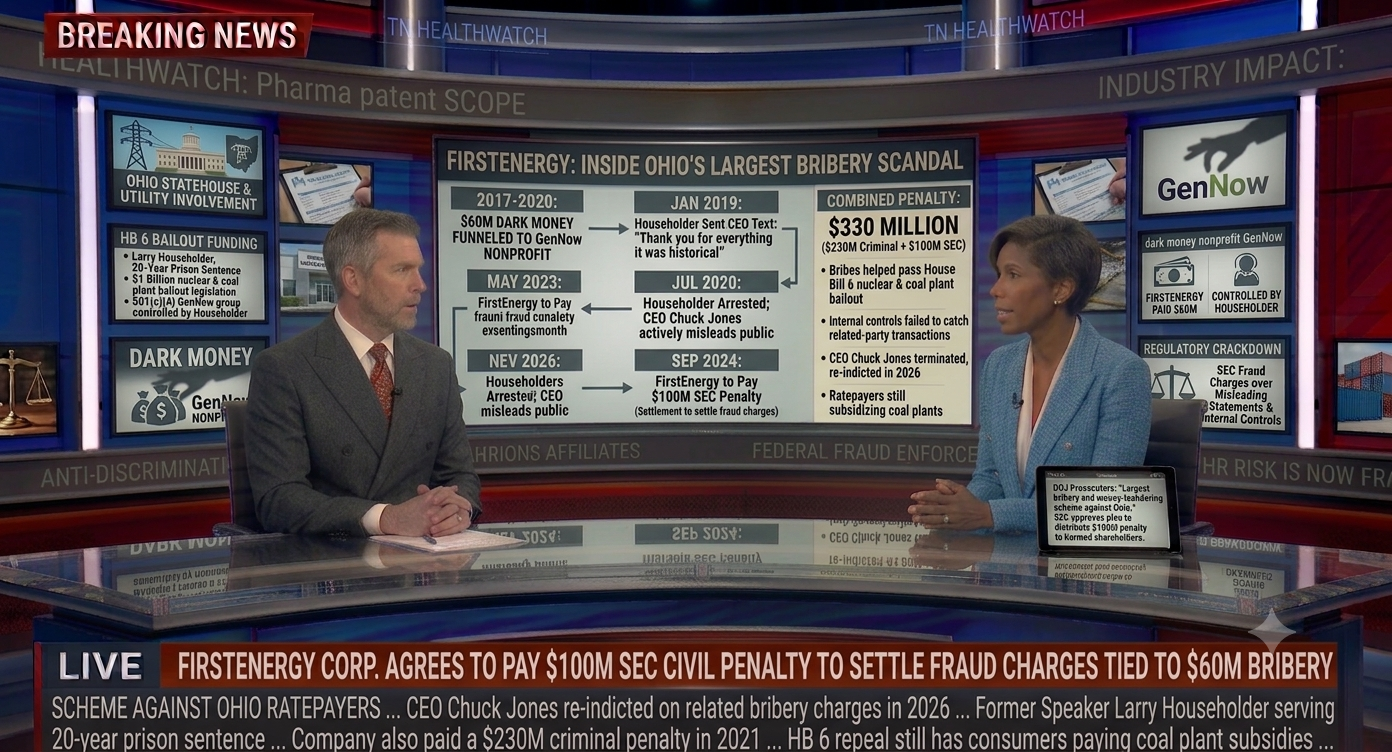
FirstEnergy Corp., the Akron, Ohio-based electric utility, agreed to pay the U.S. Securities and Exchange Commission (SEC) a $100 million civil penalty to settle fraud charges tied to its role in what federal prosecutors have called the largest bribery and money-laundering scheme ever perpetrated against the people of Ohio. And that $100 million wasn’t even the first massive check the company had to write.
The Penalty, By the Numbers
- $100 million — the civil penalty FirstEnergy agreed to pay the SEC in September 2024
- $230 million — a separate, earlier criminal penalty FirstEnergy paid in 2021 as part of a deferred prosecution agreement
- $330 million — FirstEnergy’s combined total financial penalty across both the criminal and civil resolutions
- ~$60 million — the amount FirstEnergy and its subsidiary funneled to Householder’s dark-money group between 2017 and 2020
- $1 billion — the size of the nuclear and coal plant bailout created by the legislation at the center of the scandal, House Bill 6
- 20 years — the prison sentence handed to former Ohio House Speaker Larry Householder after his criminal conviction
- $500 million+ — the amount Ohio electricity ratepayers have paid in coal plant subsidies tied to the same law, even after it was eventually repealed
What Actually Happened
The scandal centers on House Bill 6, a piece of Ohio legislation passed in 2019 that created a roughly $1 billion bailout for financially struggling nuclear and coal power plants — plants connected to FirstEnergy’s business. According to the SEC, getting that bill passed wasn’t left to normal lobbying. Between 2017 and 2020, FirstEnergy and its subsidiary, FirstEnergy Solutions, funneled approximately $60 million to an organization called Generation Now, commonly known as “GenNow.”
GenNow was structured as a 501(c)(4) nonprofit — a type of organization that, under U.S. tax law, isn’t required to publicly disclose where its donations come from, sometimes referred to as “dark money.” According to the SEC, FirstEnergy’s own internal materials specifically described this kind of dark-money giving as the company’s “preferred manner of giving.”
The catch: GenNow wasn’t an independent charity. It was controlled by Larry Householder, a member of the Ohio House of Representatives who was elected Speaker of the House in January 2019 — the same chamber that would go on to pass House Bill 6 just months later.
Four Specific Goals, According to the SEC
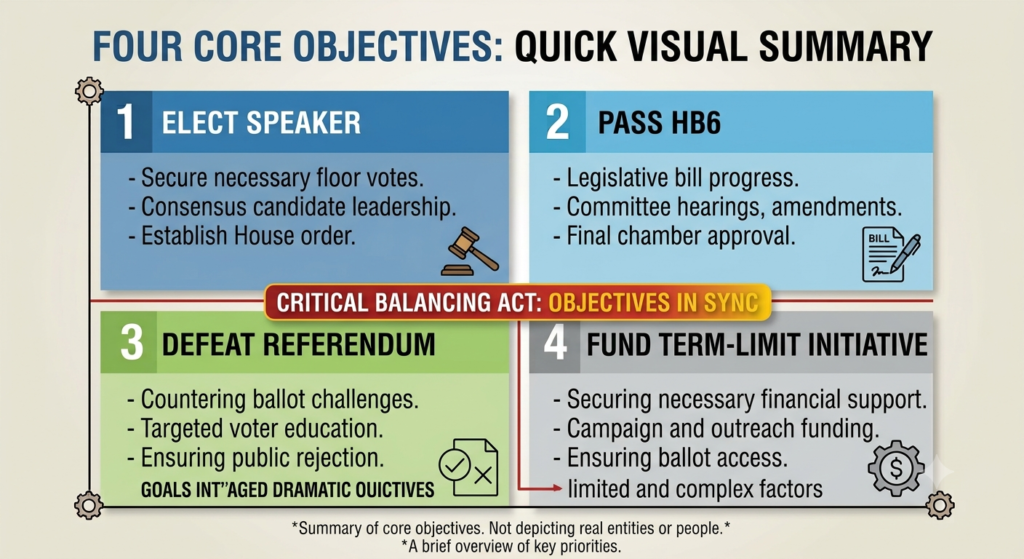
The SEC’s order lays out that FirstEnergy’s payments weren’t random political giving — they were tied to four specific objectives:
- Helping Householder get elected Speaker of the Ohio House in the first place
- Helping Householder gather legislative support to actually pass House Bill 6
- Defeating a ballot referendum effort that would have let Ohio voters repeal the law after it passed
- Funding a term-limit initiative championed by Householder, which could have allowed him to remain in power for up to 16 additional years
To help conceal FirstEnergy as the true source of some of these payments, the company also routed millions of dollars through a second 501(c)(4) group called Partners for Progress, which — despite appearing independent on paper — was actually controlled in part by former FirstEnergy executives themselves, according to the company’s own admissions in its earlier criminal settlement.
One detail in the SEC’s order captures just how directly connected the payments and the political outcome were. The day Householder was elected Speaker in January 2019 — a race FirstEnergy’s payments had specifically helped fund — Householder sent a text message to then-FirstEnergy CEO Charles “Chuck” Jones:
“Thank you for everything it was historical.”
The Cover-Up: Misleading Investors After the Arrest
The scandal became public in dramatic fashion. On July 21, 2020, federal prosecutors arrested Householder and unsealed a criminal complaint detailing the bribery scheme. Rather than coming clean, FirstEnergy and CEO Chuck Jones spent the following two days actively misleading the public and investors about the company’s involvement.
In a press release and again during a July 24, 2020 earnings call, Jones told investors:
“I believe that FirstEnergy acted properly in this matter.”
According to the SEC, that statement — along with several similar ones Jones made about the company’s ethics and his own lack of involvement with a related subsidiary — was false. As CEO, the SEC alleges Jones had been directly involved in facilitating the corrupt payments and was well aware of them at the exact moment he was publicly denying any wrongdoing.
[Image suggestion: Simple “public statement vs. private knowledge” split graphic — a quote bubble saying “we acted ethically” next to a document icon labeled “internal knowledge of the scheme” — illustrating the alleged disconnect without depicting any real individual]
What FirstEnergy Failed to Disclose
Beyond the misleading statements, the SEC also found that FirstEnergy broke basic financial reporting rules. The company failed to disclose roughly $20 million in payments to Partners for Progress as “related party transactions” in its 2019 annual report — a legal requirement anytime a company transacts with an entity connected to its own executives. The SEC also found FirstEnergy’s internal bookkeeping described the GenNow payments in ways that were inconsistent with what the payments actually were, and that the company simply lacked adequate internal controls to catch any of this in the first place.
FirstEnergy’s Response
FirstEnergy’s current president and CEO, Brian X. Tierney — who took over after the scandal broke — issued a statement following the SEC settlement, framing it as a step toward moving past the scandal:
“We are pleased to have reached a resolution with the SEC as we continue to turn a new chapter.”
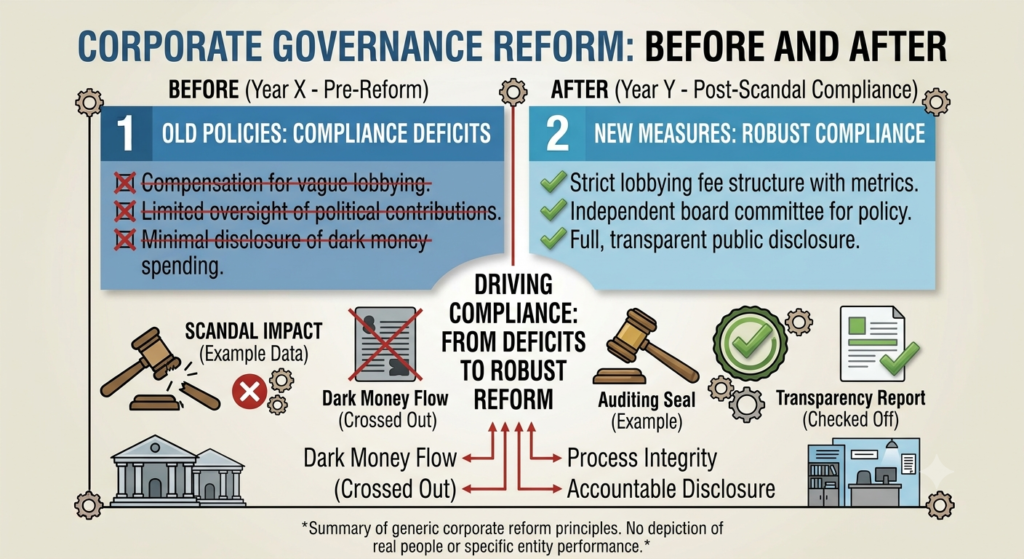
As part of settling with the SEC, FirstEnergy didn’t admit or deny the specific findings but did agree to a range of remedial steps, including terminating the executives involved (including Jones), overhauling its political activity and lobbying disclosure policies, and hiring new compliance and legal leadership.
What Happened to the People Involved
The human consequences of this scandal have played out over several years. Larry Householder was convicted by a jury in March 2023 on racketeering charges and is currently serving a 20-year federal prison sentence. Sam Randazzo, the former head of Ohio’s utility regulator who was also implicated in the broader scheme, died before his case reached trial.
Chuck Jones, FirstEnergy’s former CEO, was terminated by the company in October 2020. He has separately faced both civil fraud charges from the SEC and criminal charges at the state level — a Summit County grand jury re-indicted him, alongside former FirstEnergy Senior Vice President Michael Dowling, on bribery-related charges as recently as June 2026. Notably, a federal judge dismissed a related $20 million civil lawsuit against Jones in June 2026, ruling that he had no independent legal duty to personally disclose the dark-money payments to the SEC and investors — a distinction from the separate SEC case still proceeding against him.
The Bill Ohio Ratepayers Are Still Paying
Even though House Bill 6 was eventually repealed in August 2025, the financial damage to ordinary Ohio electricity customers didn’t disappear. Ratepayers are estimated to have paid more than $500 million in coal plant subsidies tied to the law before its repeal. In November 2025, Ohio’s utility regulator separately ordered FirstEnergy to pay a combined $250.70 million in customer restitution and civil forfeitures for related violations — a bill entirely separate from the SEC and criminal penalties described above.
The scandal has also continued to surface in Ohio politics well after the original arrests. Sitting U.S. Senator Jon Husted, who championed House Bill 6 as Ohio’s lieutenant governor at the time, testified as a defense witness in a related trial earlier this year. Husted has not been charged with any wrongdoing in connection with the scandal.
Where the Money Goes Now
In a small measure of relief for harmed shareholders, the SEC approved a plan in May 2026 to actually distribute the $100 million penalty to investors who purchased FirstEnergy common stock between January 1, 2017, and November 19, 2020 — the window during which the company’s misleading statements to the market were in effect.
The Bottom Line
What began as a seemingly ordinary piece of energy legislation turned into what federal prosecutors describe as the largest bribery and money-laundering scheme in Ohio’s history — funded quietly through dark money, protected publicly through denials from the company’s own CEO, and ultimately paid for twice over: once by FirstEnergy in corporate penalties totaling $330 million, and again by Ohio ratepayers, whose electricity bills are still absorbing the cost years after the scheme first came to light.
Sources referenced:
Common Cause Ohio – “House Bill 6 Scandal Timeline: Ohio’s Largest Corruption Case”