

Winning at trial is one thing. Having your own expert witness accidentally help sink your case on appeal is another thing entirely.
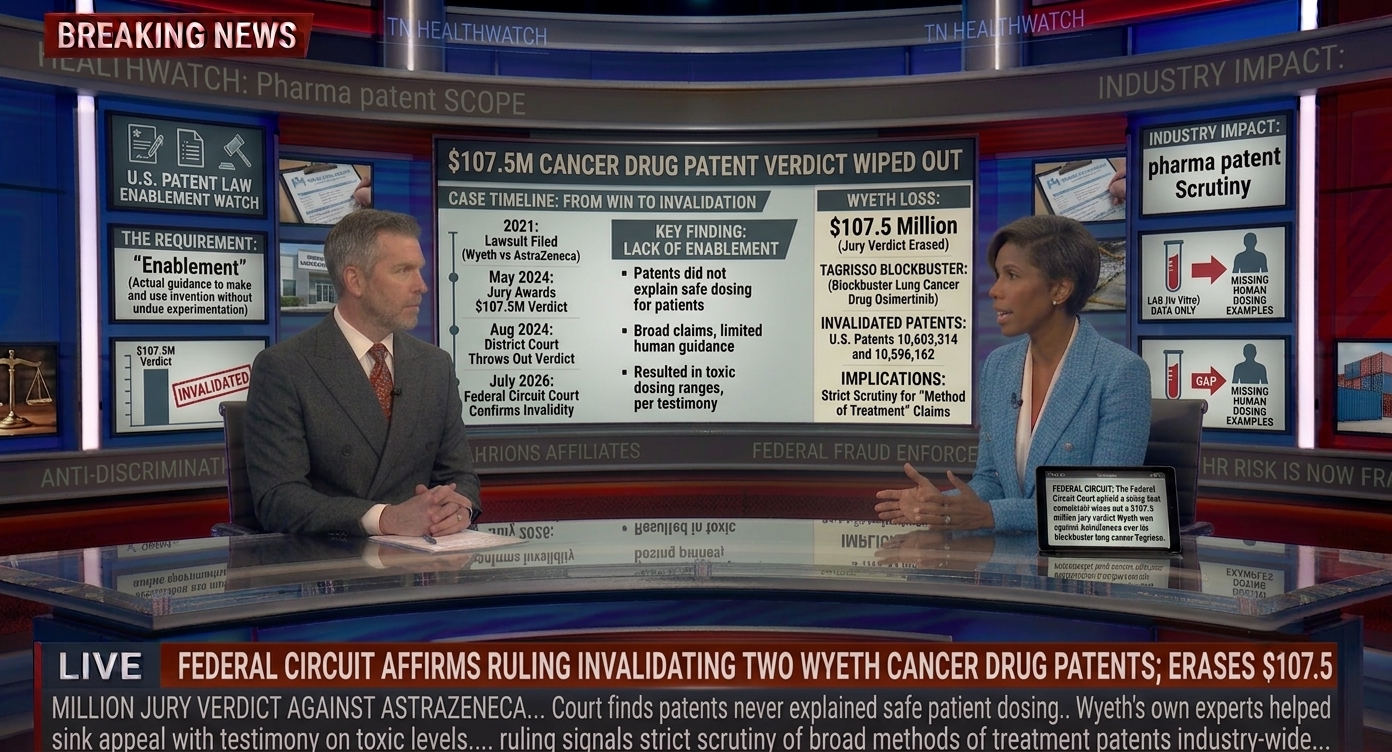
The U.S. Court of Appeals for the Federal Circuit has affirmed a ruling that completely wipes out a $107.5 million jury verdict Wyeth, a subsidiary of Pfizer, had won against AstraZeneca over its blockbuster lung cancer drug Tagrisso. The reason: the court found Wyeth’s own patents never actually explained how to safely dose the treatment they claimed to have invented.
The Case, By the Numbers
- $107.5 million — the jury verdict originally awarded to Wyeth in May 2024, now permanently invalidated
- 2 patents — the number of Wyeth patents (U.S. Patents 10,603,314 and 10,596,162) found invalid
- 3 compounds — the total number of example compounds Wyeth’s patents actually described, despite the patents claiming to cover an entire broad category of cancer-fighting compounds
- 0 — the number of working human dosing examples included anywhere in the patents’ technical descriptions
- 5x — how many times higher one of the disclosed compound’s effective dosage levels were, according to testimony, compared to what could actually be safely given to a real patient
- 2021 — the year Wyeth originally filed its lawsuit against AstraZeneca
The Drug and the Science Behind the Dispute
Tagrisso (chemical name: osimertinib) is one of AstraZeneca’s best-selling drugs, used to treat a form of lung cancer called non-small cell lung cancer (NSCLC) — specifically, cases that have become resistant to two older cancer drugs, gefitinib and erlotinib. Tagrisso works as an “irreversible” inhibitor, meaning it permanently binds to a specific protein involved in cancer cell growth, rather than temporarily blocking it the way older drugs do.
Wyeth owned two patents that it argued covered exactly this kind of treatment approach — administering a daily dose of an irreversible cancer-fighting compound that binds to a specific location on that same protein. In 2021, Wyeth sued AstraZeneca, arguing that Tagrisso’s sales infringed on those patents.
The Jury Sided With Wyeth — At First
The case went to a five-day trial in the U.S. District Court for the District of Delaware. The jury concluded that Wyeth’s patents were valid and that AstraZeneca had induced infringement of them through its marketing and sale of Tagrisso, awarding Wyeth $107.5 million in damages.
That victory didn’t last. AstraZeneca asked the trial judge to override the jury’s verdict, arguing that no reasonable jury could have found the patents valid in the first place, because they failed a fundamental legal requirement for any patent: actually teaching people how to use the invention.

The Legal Problem: “Enablement”
Here’s the technical concept at the heart of this entire case. Under U.S. patent law, an inventor can’t just claim they’ve discovered something — the patent itself has to actually teach other skilled professionals in the field how to make and use the invention, without requiring excessive additional trial-and-error. This requirement is called “enablement,” and courts have described the underlying principle simply:
“The more one claims, the more one must enable.”
Wyeth’s patents claimed a very broad category: essentially any compound that could bind to a specific location on the target protein, administered in a daily “unit dosage” to a human patient. But the patents themselves only described three specific example compounds, and for those, they only provided laboratory (in vitro) test-tube results — not any actual examples of dosing real human patients.
The Detail That Sank the Case: Some of the Doses Would Be Toxic
The most damaging evidence in the whole case didn’t even come from AstraZeneca’s own experts — it came from Wyeth’s. During trial testimony, one of the patents’ own co-inventors testified that the drug concentrations described in the patents were roughly five times higher than what could actually be safely given to a patient, explaining that lab-based concentrations don’t always translate to something a human body can tolerate.
Wyeth’s own invalidity expert further agreed that when calculating a real-world dosage, a skilled professional would obviously want to avoid toxic doses — directly undercutting Wyeth’s argument that the broad, general dosage ranges listed in the patents were good enough guidance on their own.
The District Court’s Ruling, and the Appeal
Judge Matthew F. Kennelly, presiding in Delaware, sided with AstraZeneca after trial, formally throwing out the jury’s verdict in August 2024. He concluded the patents provided, in his words, only “a starting point” for future research, rather than a genuine, ready-to-use invention — leaving skilled professionals to essentially reinvent the missing pieces themselves through trial and error.
Wyeth appealed, arguing the trial judge had unfairly added extra safety and effectiveness requirements to the patents that were never actually part of the original claims. The Federal Circuit disagreed. A three-judge panel, in a decision written by Judge Alan Lourie, concluded the trial court hadn’t invented any new requirements — it had simply held Wyeth to the dosing language the patents themselves already contained, since the patents specifically required a dose to be administered “daily” to a “patient.”
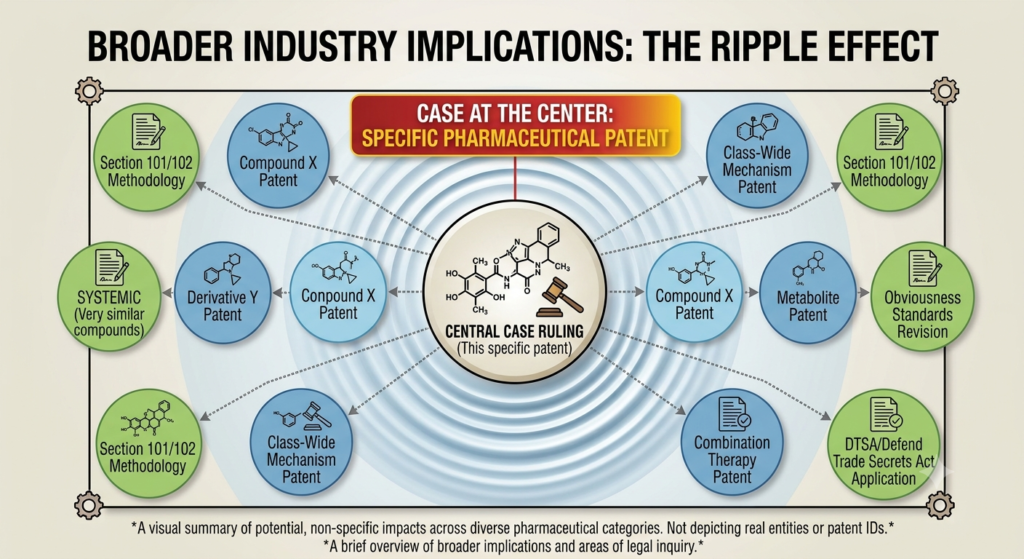
What This Means Beyond Just Wyeth and AstraZeneca
Legal analysts tracking pharmaceutical patent law have flagged this decision as a significant one, extending well beyond this single case. It reinforces a trend, following a 2023 U.S. Supreme Court ruling in an unrelated case, toward much stricter scrutiny of “method of treatment” patents — the kind of patents companies often file before they have complete human clinical data in hand.
The takeaway for the pharmaceutical industry, according to multiple legal commentators: a patent can describe a promising scientific concept in broad, general terms, but if it doesn’t provide real guidance on how to safely translate that concept into an actual daily treatment for patients, courts are now more willing to strike the whole thing down — regardless of how much money was originally awarded at trial.
The Bottom Line
A pharmaceutical patent dispute that once resulted in a $107.5 million jury verdict for Wyeth has now ended with the exact opposite outcome: both underlying patents invalidated, and the verdict permanently erased. The deciding factor wasn’t whether the underlying science was legitimate — it was whether the patents actually told anyone how to safely use it on a real patient. According to two federal courts now, they didn’t.
Sources referenced:
BioSpace – “Delaware Judge Throws Out Pfizer’s $107.5M Tagrisso Patent Win Over AstraZeneca”
Mondaq – “The $107.5 Million Dosage Gap: Enablement Lessons From Wyeth v. AstraZeneca”
Patently-O – “Narrowed to Clear the Art: The Enablement Cost of Wyeth’s Unit Dosage Claims”
Cooley LLP – “Enablement Risks for Method of Treatment Claims After Wyeth v. AstraZeneca”