
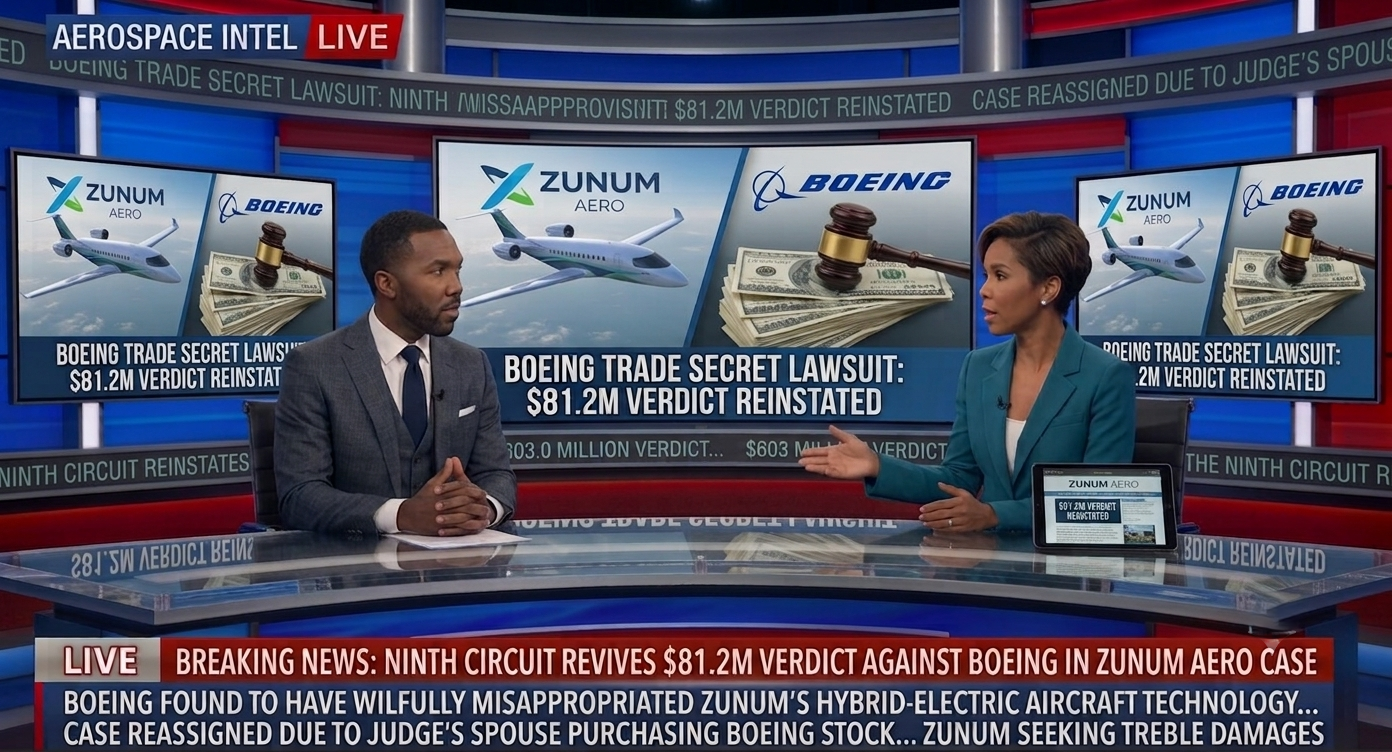
A defunct electric airplane startup just got its win back — and the judge who took it away got taken off the case.
The Ninth Circuit Court of Appeals has reinstated an $81.2 million jury verdict against The Boeing Company, ruling that a federal judge was wrong to throw out a jury’s finding that Boeing stole trade secrets from Zunum Aero, a now-shuttered startup that once partnered with the aerospace giant to build hybrid-electric aircraft. To make the story even more remarkable, the appeals court also ordered the case reassigned to a different judge, after it emerged that the original judge’s spouse had bought Boeing stock while the case was still being decided.
The Verdict, By the Numbers
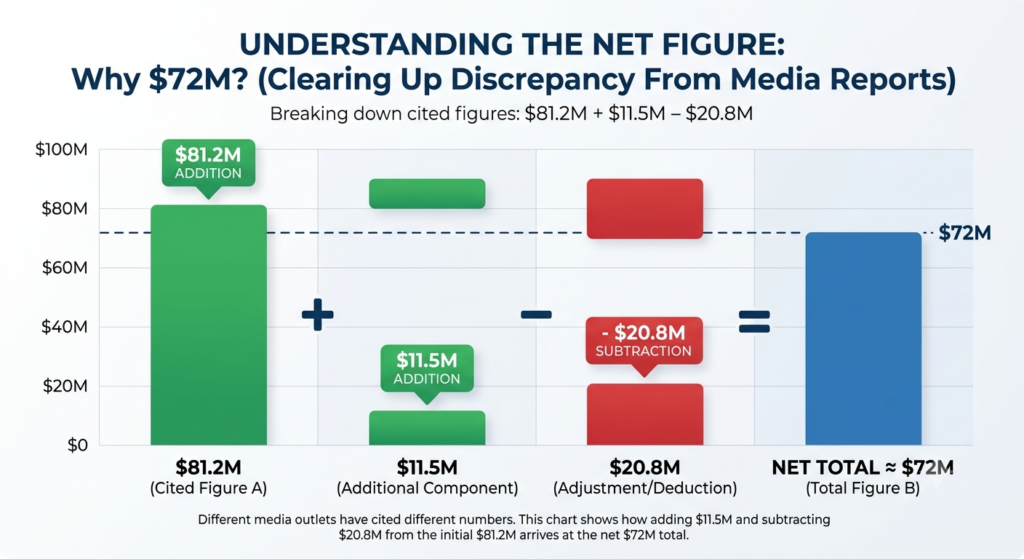
- $81.2 million — the jury’s original combined damages award for trade secret misappropriation, breach of contract, and unjust enrichment
- $11.5 million — additional damages awarded for tortious interference with Zunum’s business relationship with French aerospace company Safran S.A.
- $20.8 million — deducted by the jury because it found Zunum could have taken steps to reduce its own losses, bringing the net verdict to roughly $72 million
- 11 of 19 — the number of alleged trade secrets the jury found Boeing had actually misappropriated
- 8 days — the length of the original trial
- 9 members — the size of the unanimous jury that reached the verdict
- The case could still grow significantly larger, since the jury found Boeing’s conduct “willful and malicious,” opening the door to potentially tripling the trade-secrets portion of the award in further proceedings
How This Fight Started
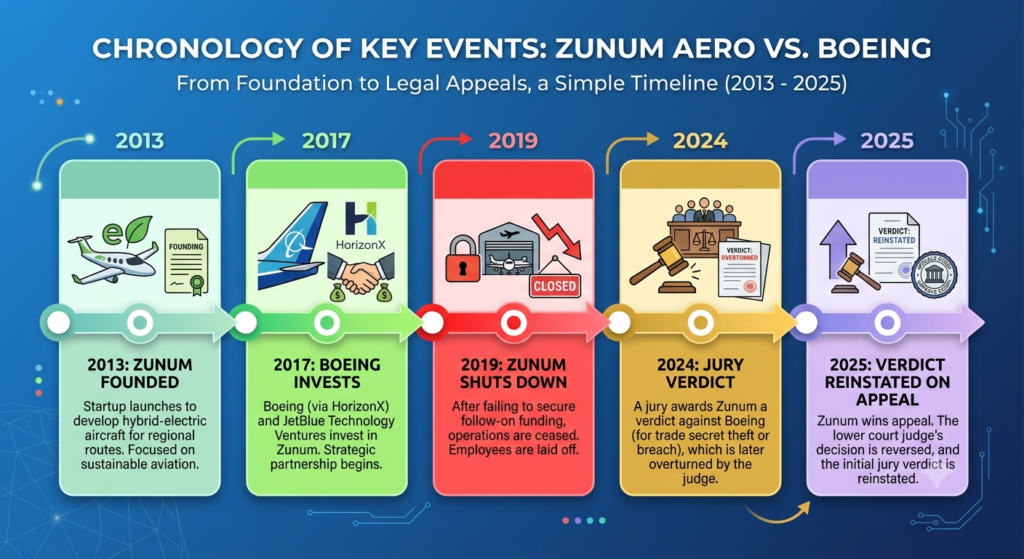
Zunum Aero, founded in 2013 and based in the Seattle area, set out to build a nine-seat hybrid-electric aircraft designed for short regional flights — the kind of ambitious clean-aviation idea that attracted real institutional interest. Boeing HorizonX Ventures, Boeing’s venture capital arm, invested in Zunum starting in 2017, alongside funding from JetBlue Technology Ventures and an $800,000 grant from Washington State’s Clean Energy Fund.
As part of that investment, Boeing signed agreements — including a 2017 investor rights letter — restricting how it could use any confidential information it gained access to through the partnership. Zunum’s core allegation: Boeing didn’t just invest, it used that access to study Zunum’s proprietary technology, then began developing its own competing hybrid-electric aircraft program using what it learned. Zunum also claimed Boeing used its industry weight to discourage other potential investors and partners, ultimately contributing to Zunum ceasing most of its operations and laying off its staff back in 2019.
The Original Jury Verdict
The case finally reached trial in the U.S. District Court for the Western District of Washington, in front of Judge James L. Robart. After an eight-day trial, the jury delivered a sweeping win for Zunum on May 30, 2024, finding that Boeing had misappropriated 11 of Zunum’s 19 claimed trade secrets, breached one of two contracts between the companies, and tortiously interfered with Zunum’s budding relationship with Safran, a major French aerospace company that had been exploring a potential investment and partnership.
Zunum’s lead counsel at the time, Scott Danner of law firm Holwell Shuster & Goldberg, called the verdict a long-awaited vindication for the startup’s founders and shareholders after years of litigation.
Then a Judge Took It All Away
That win didn’t last. In August 2024, Judge Robart granted Boeing’s request to throw out the verdict entirely — a legal move called “judgment as a matter of law,” which lets a judge override a jury’s decision if the judge concludes no reasonable jury could have reached it. Robart ruled that Zunum had only provided what he called “vague and amorphous descriptions” of its trade secrets, concluding the startup failed to prove it actually had protectable intellectual property in the first place.
In a memorable turn of phrase, Robart had actually described the jury’s verdict as “an electrifying win for Zunum” — right before reversing it entirely just paragraphs later in the same order.
The Twist: The Judge’s Own Boeing Stock
Here’s where the story takes an unusual turn. One day before entering final judgment in Boeing’s favor, Judge Robart disclosed something significant: his spouse held a traditional IRA account, with investment decisions delegated to a bank, and that account had purchased Boeing stock on two separate occasions while the lawsuit was still active.
According to the appeals court’s own account of events, Robart learned about both stock purchases from routine account statements within weeks of each transaction, back in May and June 2023. But he didn’t disclose any of it to the parties involved until September 2024 — well over a year later, and notably, only after describing the situation as an “error” during a media interview that same August.
The Ninth Circuit’s panel of judges found that timeline troubling enough to flag on its own. Their written ruling didn’t hold back:
“This delayed disclosure…could give an objective observer reason to question the district judge’s impartiality.”

The Ninth Circuit’s Ruling
A three-judge appeals panel reviewed the case and firmly disagreed with how Judge Robart had handled it. The court ruled that Zunum had, in fact, presented sufficiently specific evidence identifying its trade secrets at trial, and that the jury had substantial evidence to support every one of its findings — including that Boeing’s own internal communications showed employees discussing how difficult it would be to replicate Zunum’s technology, and separately, discussing modifying Boeing’s own designs to incorporate Zunum’s innovations.
The panel also reinstated the jury’s findings on the breach of contract and tortious interference claims, ruling that Judge Robart had improperly reweighed evidence and failed to give Zunum the benefit of reasonable inferences the law requires at this stage of a case.
With the entire jury verdict restored, the appeals court sent the case back down to the district court — but specifically instructed that it be handled by a different judge going forward, citing the stock-disclosure issue as a legitimate reason to question impartiality in any further proceedings
What Attorneys Are Saying Now
Following the ruling, Vincent Levy, one of the attorneys representing Zunum, framed the decision as complete validation of the startup’s yearslong fight:
“The decision fully restores the jury’s verdict, vindicating Zunum’s hard-fought efforts to protect its groundbreaking technology.”
Boeing, for its part, has previously stated it disagreed with the jury’s original verdict, arguing it wasn’t supported by the law or the facts, and has indicated it would continue challenging the case going forward.
What Happens Next
With the verdict reinstated and a new judge now assigned to the case, a few things remain unresolved. The question of whether the trade-secrets portion of the damages should be tripled, based on the jury’s finding that Boeing’s conduct was willful and malicious, still needs to be litigated. There’s also a separate, smaller wrinkle: earlier in the case, Zunum was ordered to repay Boeing roughly $9 million in loans, plus interest, related to a portion of the breach-of-contract dispute Boeing had actually won — meaning any final number will likely net out to something different from the headline $81.2 million figure once all the offsetting awards are accounted for.
The Bottom Line
A startup that set out to reinvent regional air travel lost its jury verdict once, on paper, in a judge’s ruling — only to get it back on appeal, alongside a pointed message from a federal appeals court about the importance of judicial impartiality. Whether the final number ends up closer to $72 million, $81 million, or something larger if damages get tripled, this case is a reminder that even a jury’s unanimous verdict isn’t always the final word — and neither, it turns out, is a judge’s.
Sources referenced:
“Ninth Circuit Revives $72 Million Verdict Against Boeing in Trade Secret Case”
“US Court Sides With Zunum (Again), Reinstating $81M Verdict Against Boeing”
The Seattle Times – “Judge overturns $72M jury verdict, clears Boeing in Zunum lawsuit”
Bloomberg Law – “Boeing Ducks $72 Million Verdict as Judge Finds No Trade Secrets”