


Nine days. That’s reportedly how long it took a semiconductor components company to turn someone else’s stolen blueprints into finished product designs. It’s also, apparently, not fast enough to avoid a multi-year legal reckoning — one that just took a dramatic turn on appeal.
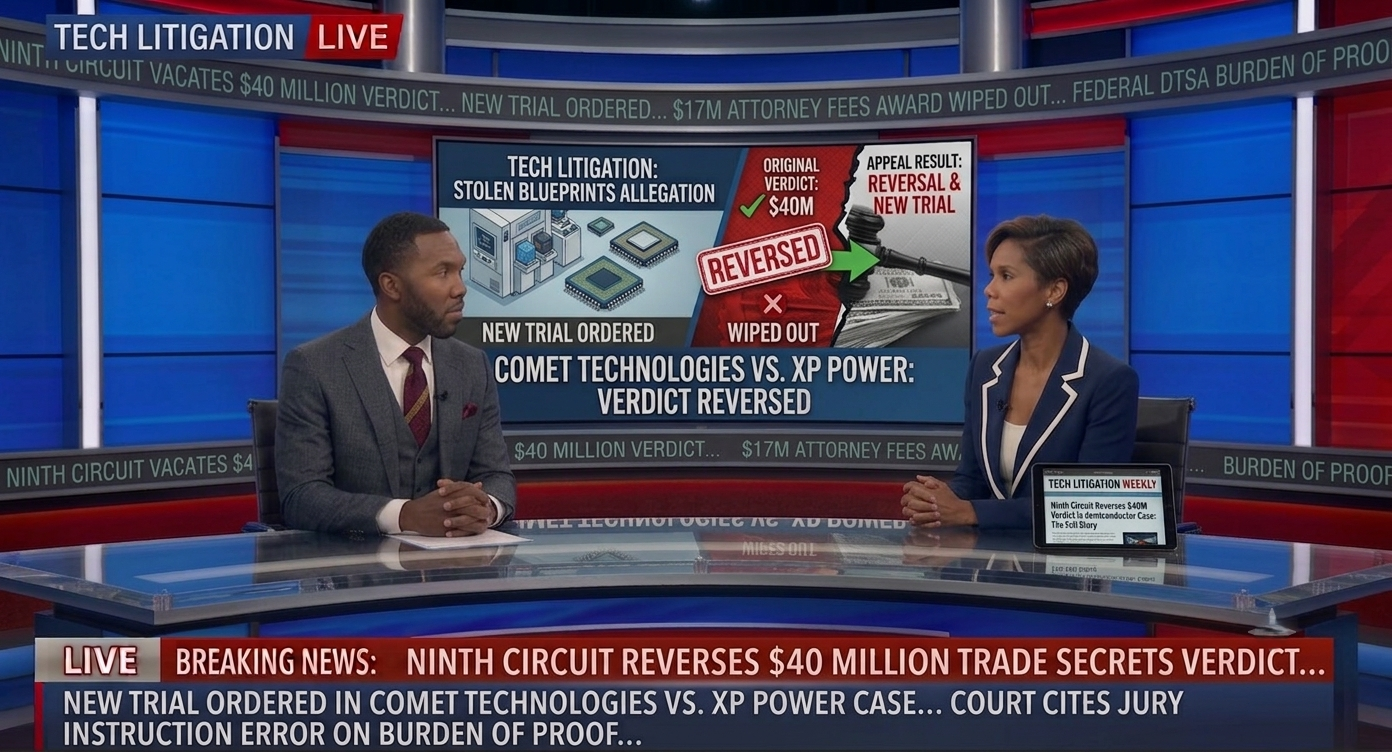
The Ninth Circuit Court of Appeals has reversed a $40 million jury verdict against XP Power, LLC, wiping out the damages award, a permanent injunction, and a separate $17 million attorney fee award, all because a trial court gave the jury the wrong instructions on a single, critical legal question. The case now heads back for an entirely new trial.

The Verdict That Got Wiped Out
- $40 million — the total original verdict: $20 million in compensatory damages plus $20 million in punitive damages
- $5 million — awarded specifically for misappropriation of one trade secret (referred to in court as “Trade Secret D”)
- $15 million — awarded for a second trade secret (“Trade Secret E”)
- $0 — awarded for a third trade secret the jury found was misappropriated but didn’t assign standalone damages to (“Trade Secret L”)
- $17 million+ — separate attorney fees awarded to the winning side after trial
- 9 days — how quickly the new employer allegedly had complete product designs and a development plan using the stolen information
- All of the above has now been reversed and vacated entirely, pending a new trial
How the Theft Allegedly Happened
The case traces back to February 2018, when a senior engineer named Christopher Mason, along with two colleagues, left their jobs at Comet Technologies — a company that makes radio-frequency components used in manufacturing computer chips — to go work for a competitor, XP Power. According to court records, they didn’t leave empty-handed: they allegedly brought along thousands of confidential documents and files detailing Comet’s product designs, research strategies, and underlying technology.
The most dramatic piece of evidence in the entire case reportedly came from a recorded phone call. While Mason was still employed at Comet, he allegedly contacted a headhunter working for XP and offered to bring over a ready-made “crew” that could deliver a “turnkey” — meaning already complete — product design. The headhunter recorded that call and forwarded it straight to XP’s CEO and other senior executives, adding a note that has since become a memorable line in the court record:
“Please keep this recording strictly confidential. You will see why.”

The Original Trial and Verdict
Comet sued XP under the federal Defend Trade Secrets Act (DTSA), along with a parallel claim under California’s Uniform Trade Secrets Act (UTSA). Comet originally claimed 20 separate trade secrets had been stolen, but narrowed that list down to just five specific claims before trial, labeled Trade Secrets D, E, L, S, and T.
The case went to trial in the U.S. District Court for the Northern District of California, presided over by Magistrate Judge Nathanael M. Cousins in San Jose. Partway through the trial, Comet made a strategic decision that would later become the entire focus of the appeal: it voluntarily dropped its California state law claims, choosing to proceed only under the federal DTSA.
The jury ultimately found that XP had misappropriated three of the five trade secrets — D, E, and L — and that the misappropriation was done willfully and maliciously. The jury awarded $20 million in compensatory damages and matched it with $20 million in punitive damages, for a combined $40 million verdict. The court also issued a permanent injunction barring XP from using the stolen information going forward, and later tacked on more than $17 million in attorney fees.
So Why Did the Appeals Court Throw It Out?
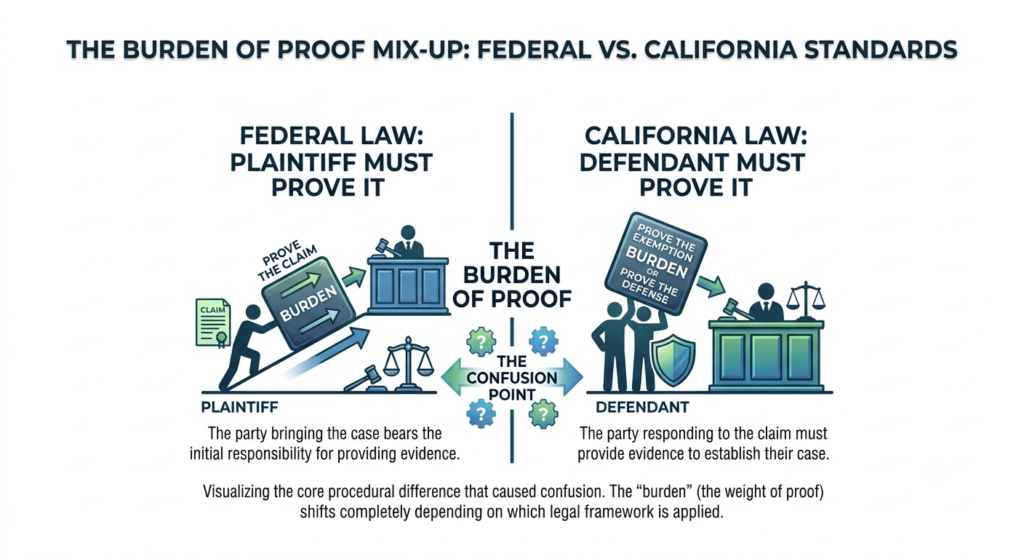
Here’s the crux of the whole case, and it comes down to one seemingly small but legally significant detail: who has to prove what.
Under the federal DTSA, a company suing over stolen trade secrets has to prove its information was not “readily ascertainable by proper means” — in plain terms, that a competitor couldn’t have simply figured it out through legitimate work like reverse-engineering or public research. That’s the plaintiff’s job to prove.
But under California’s separate state law, it works the opposite way — the defendant has to prove the information was easily obtainable as a defense. Since Comet originally filed under both laws, the trial court’s jury instructions were written to fit that dual-claim structure. The problem: once Comet dropped its California claims partway through trial and proceeded only under federal law, the instruction should have flipped to put that burden back on Comet — and it never did.
XP’s lawyers actually caught this and asked the judge to fix it. The judge declined, and left the incorrect instruction in place. The Ninth Circuit ruled that this wasn’t a small technicality — it affected a core legal element of the entire case, and the appeals court couldn’t be confident the jury would have reached the same verdict, or awarded the same dollar amounts, if it had been instructed correctly from the start.
A Split Decision, With Sharp Disagreement
This wasn’t a unanimous ruling. The three-judge panel included a full concurring opinion and a full dissent, showing just how contested this legal question really was.
In the dissent, one judge agreed the instruction was technically wrong, but argued the mistake didn’t actually matter — pointing to what he described as overwhelming, largely unchallenged evidence at trial that XP’s information genuinely wasn’t something a competitor could have easily reverse-engineered. In his view, sending the whole case back for a brand-new trial wasn’t necessary.
The majority disagreed, concluding that both sides had presented real, conflicting expert testimony on exactly this question — meaning it was a factual dispute the jury needed to resolve under the correct legal standard, not something an appeals court could simply assume the answer to after the fact.
Separately, one judge wrote an additional concurring opinion addressing a completely different legal question likely to resurface if Comet wins again at a new trial: whether a company can be awarded both monetary damages and a permanent injunction without that counting as an improper “double recovery.” That judge concluded it does not, siding with how two other federal appeals courts have handled similar situations, while acknowledging a different appeals court reached the opposite conclusion in a separate, unrelated case.
What Happens Now
With the verdict, injunction, and attorney fee award all vacated, this case is heading back to square one on the trade secrets claims that were misappropriated — Trade Secrets D, E, and L. A brand-new trial will need to determine both liability and damages from scratch, this time under properly worded jury instructions.
Notably, not everything is being retried. The jury’s earlier finding that XP did not misappropriate one of the trade secrets (Trade Secret S), along with an earlier court ruling that fully dismissed a separate claim (Trade Secret T), were not challenged on appeal and remain untouched.
The Bottom Line
A jury spent real time weighing detailed technical evidence and delivered a decisive $40 million verdict against a company it found had stolen trade secrets and used them within days. An appeals court didn’t dispute the underlying story — it disputed whether the jury had been given the right rulebook to work from. Now, years into this dispute, both companies are headed back to square one for a new trial to settle the same questions all over again, this time with the correct instructions in hand.
Sources referenced:
FindLaw – “Comet Technologies USA Inc AG GMBH v. XP Power LLC (2026)”