






Some medical settlements involve confusing billing codes and paperwork disputes. This one involves a patient who reportedly received 42 stents over eight years — including at a time his own doctor had told him he didn’t even need dialysis.
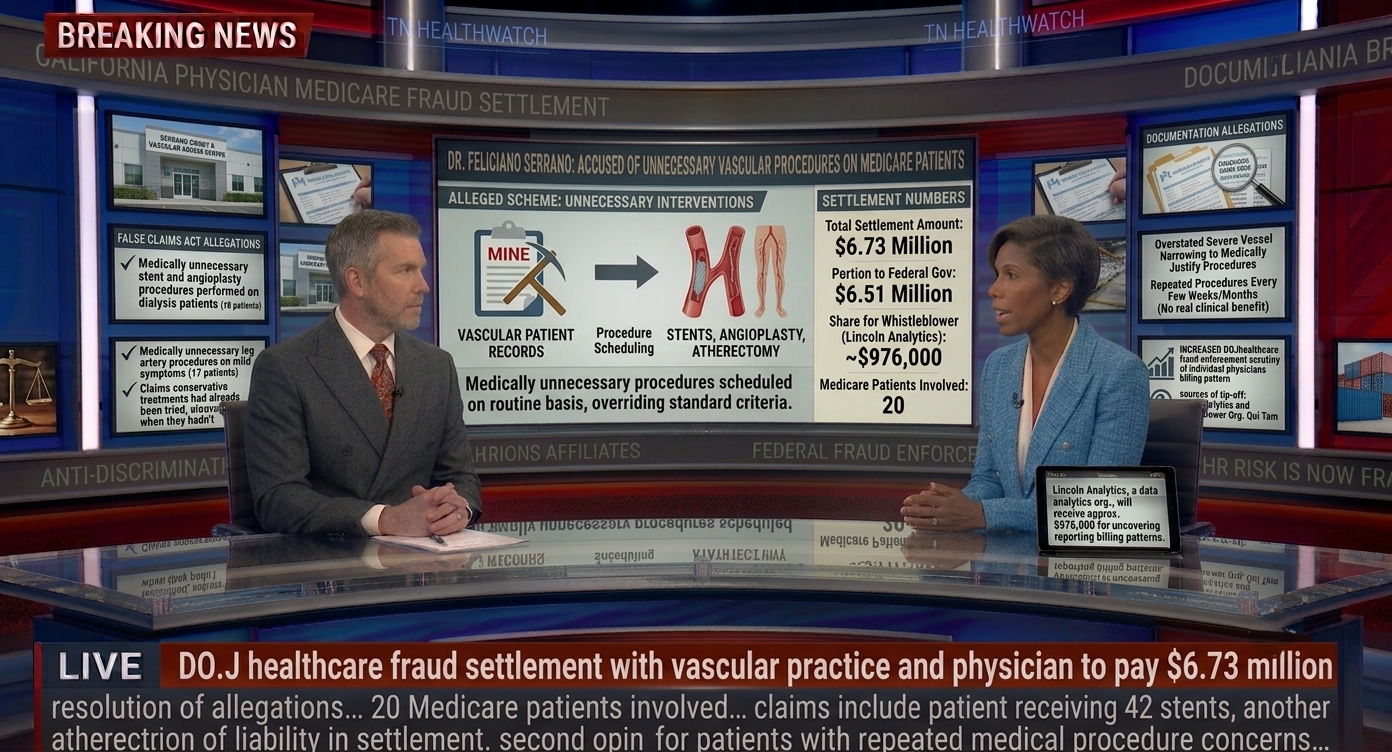
A Huntington Park, California vascular practice, Serrano Kidney & Vascular Access Center, and its physician, Dr. Feliciano Serrano, have agreed to pay more than $6.73 million to resolve federal allegations that they billed Medicare for medically unnecessary vascular procedures performed on 20 patients over nearly a decade.

The Settlement, By the Numbers
- $6.73 million — the total settlement amount
- $6.51 million — the portion going to the federal government
- ~$229,000 — the portion going to the State of California
- ~$976,000 — the share awarded to the whistleblower organization that originally brought the case forward
- 20 — the total number of Medicare patients whose procedures were flagged as medically unnecessary
- 2016 to 2024 — the years the alleged conduct is said to have taken place
- 42 — the approximate number of stents one single patient received in a dialysis-related vessel over an eight-year span
- 16 — the approximate number of atherectomy procedures a separate patient received in his legs over a four-year span
What Prosecutors Say Actually Happened
According to the Justice Department, the case centers on two separate categories of vascular procedures Dr. Serrano allegedly performed far more often, and far more aggressively, than medical necessity required.
Dialysis access interventions: Between 2016 and 2024, prosecutors allege Dr. Serrano performed unnecessary angioplasty and stent procedures on 18 patients, supposedly to treat narrowing (stenosis) in the blood vessels used for their dialysis treatment. Rather than waiting for actual complications to appear, prosecutors say he scheduled these interventions on a routine basis, and repeated procedures on the same patients every few days or weeks, even when they weren’t providing any real clinical benefit.
Peripheral artery disease interventions: Separately, between 2019 and 2024, prosecutors allege Dr. Serrano performed unnecessary stent and atherectomy procedures on 17 patients, this time to treat narrowing in leg blood vessels. According to the allegations, many of these patients had only mild symptoms, or none at all. Even when a patient reported pain in only one leg, prosecutors say Dr. Serrano performed procedures on both legs, and then repeated the procedures on both legs every few months.
The Specific Allegations That Stand Out
A few details from the government’s allegations illustrate the scale of what prosecutors say was happening. One Medicare patient reportedly received approximately 42 stents in a dialysis-related blood vessel between 2016 and 2023 — including, notably, during a stretch of time when Dr. Serrano had already told that same patient he didn’t actually need dialysis at all.
A separate patient reportedly received around 16 atherectomy procedures on his legs between 2019 and 2023.
Prosecutors also allege that Dr. Serrano told patients their legs could require amputation if they didn’t undergo the recommended procedures — even though, according to the government, patients with only mildly symptomatic peripheral artery disease face very little actual risk of amputation.

How Prosecutors Say the Records Were Handled
Beyond the frequency of the procedures themselves, the government’s core legal allegation is about documentation. Prosecutors allege that across both categories of procedures, Dr. Serrano:
- Performed interventions on blood vessels that didn’t actually qualify for treatment under accepted medical standards
- Overstated how severe patients’ vessel narrowing was, to make procedures appear medically justified on paper
- Falsely documented patient symptoms and claimed conservative treatments had already been tried, when they hadn’t
- Performed procedures at a frequency well beyond what accepted medical standards would call for
What Federal Officials Had to Say
Assistant Attorney General Brett A. Shumate of the DOJ’s Civil Division framed the case around patient wellbeing as much as fraud, stating:
“Physicians who place their own profit over patient needs will be held accountable.”
First Assistant U.S. Attorney Bill A. Essayli, for the Central District of California, emphasized the financial impact on federal healthcare programs more broadly, noting the government intends to pursue similar cases aggressively going forward.
Who Brought This Case to Light
This settlement resolves a whistleblower lawsuit filed under the False Claims Act’s qui tam provisions by Lincoln Analytics Inc., a data analytics organization that flagged the alleged billing patterns to federal investigators. Under whistleblower rules, private parties who expose fraud against government healthcare programs are entitled to a share of whatever gets recovered — in this case, Lincoln Analytics will receive approximately $976,000 as its portion of the federal recovery.

Important Context: This Is a Settlement, Not a Verdic
It’s worth being clear about what this resolution actually represents. As is standard in cases like this, the settlement explicitly states that the allegations against Dr. Serrano and his practice were never proven in court, and there has been no formal determination of liability. Agreeing to a settlement allows both sides to resolve the matter without the time, expense, and uncertainty of a trial — it isn’t the same as a guilty verdict.
The Bottom Line
Whatever the full truth turns out to be, the scale of the allegations here is striking: a single patient reportedly receiving dozens of stents over the better part of a decade, and another undergoing over a dozen leg procedures for a condition prosecutors say carried little real risk to begin with. With a whistleblower organization’s data analysis playing a central role in surfacing the pattern, this case adds to a growing list of settlements showing just how closely federal investigators are now scrutinizing individual physician billing patterns, not just large hospital systems or insurance companies.
Sources referenced:
Medical Economics – “California physician practice to pay $6.73M for unnecessary procedures”