



A $2.6 billion contract win turned into one very expensive legal headache. A federal appeals court just made sure of it.
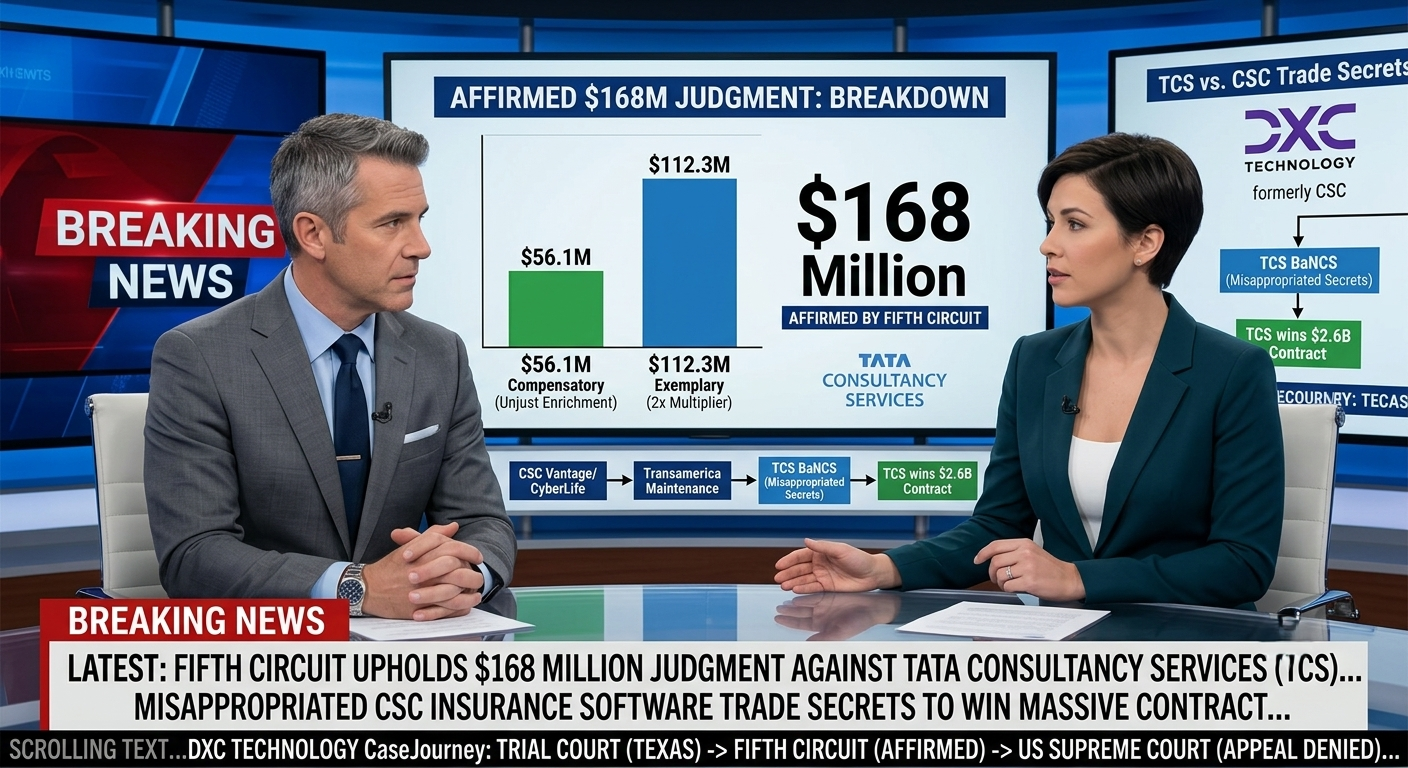
The Fifth Circuit Court of Appeals has largely upheld a $168 million judgment against Tata Consultancy Services (TCS), the India-based IT giant, ruling that TCS misappropriated trade secrets belonging to Computer Sciences Corporation (CSC) while building a competing insurance software platform and winning a massive contract with a shared client, Transamerica.
The Verdict, By the Numbers
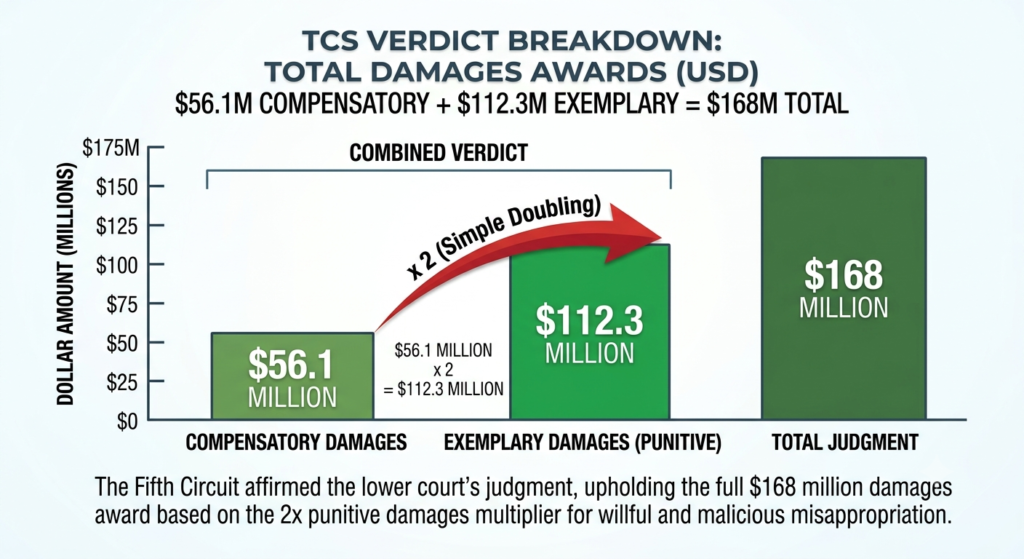
- $56,151,583 — compensatory damages, based on a “unjust enrichment” calculation of the research and development costs TCS avoided by allegedly using CSC’s stolen information instead of building its platform independently
- $112,303,166 — exemplary (punitive) damages, calculated as exactly two times the compensatory damages figure, the maximum multiplier allowed under federal trade secrets law
- $168 million — the combined total judgment, now affirmed on appeal
- $2.6 billion — the size of the contract TCS won with Transamerica, which CSC alleged was won in part using the stolen information
- 8 days — the length of the original trial, held in front of an advisory jury
- 2,200+ — the number of former Transamerica employees TCS hired as part of the transition — including staff who had previously maintained CSC’s own software platforms
How This Fight Started
Computer Sciences Corporation, an American technology services company, had licensed two insurance software platforms — called Vantage and CyberLife — to Transamerica, a major insurance company, going all the way back to agreements signed in the 1990s. Years later, Transamerica brought in Tata Consultancy Services as a third-party consultant to help maintain those same CSC platforms, under an agreement that only allowed TCS to access CSC’s confidential software “solely for the benefit” of Transamerica.
Around the same time, TCS was quietly trying to break into the U.S. insurance software market with its own competing product, called BaNCS. In 2017, Transamerica opened a bidding process to modernize its systems, and TCS submitted a proposal — ultimately winning a $2.6 billion contract to move Transamerica’s entire business over to the BaNCS platform.
The Email That Blew the Whole Thing Open
CSC had actually been raising concerns for years, sending Transamerica letters as early as February 2018 asking for reassurance that its confidential information was being protected. Both Transamerica and TCS repeatedly assured CSC that nothing improper was happening.
Then, in March 2019, a CSC employee was accidentally copied on an internal email chain between TCS staff. According to court records, the emails showed TCS employees sharing excerpts of CSC’s actual source code and technical manuals, specifically while trying to figure out how one of CSC’s calculations — something CSC considered a genuine trade secret — actually worked. That accidental discovery is what triggered CSC’s lawsuit just a few months later, in August 2019.
The Trial and the District Court’s Findings
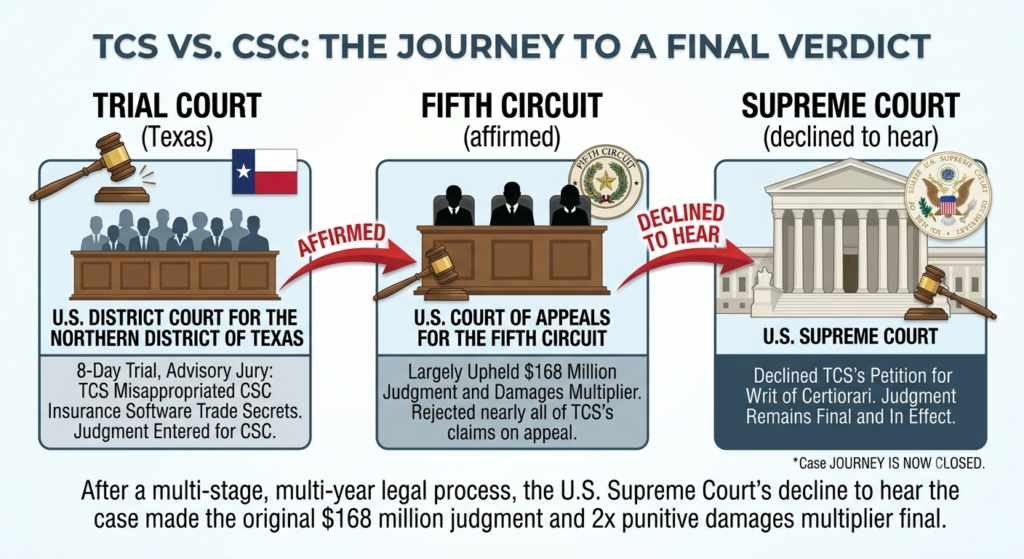
The case went to trial in the U.S. District Court for the Northern District of Texas, where an advisory jury sided with CSC on every key question, finding that TCS had acquired CSC’s information improperly, used it without authorization, and did so willfully and maliciously. The trial judge went on to make a series of pointed factual findings against TCS, concluding in part:
“TCS knew its misappropriation of the Trade Secrets was wrong.”
The court also found that TCS had misrepresented to Transamerica that its newly hired, formerly-Transamerica employees weren’t using any third-party intellectual property to build BaNCS’s features — even as internal TCS communications showed the opposite was happening.

What the Fifth Circuit Decided
TCS appealed on six separate grounds, and the Fifth Circuit rejected nearly all of them. The appeals court agreed with the trial court that:
- TCS’s access to CSC’s information was not authorized under the relevant contracts, since those contracts limited TCS’s use of the software strictly to Transamerica’s benefit — not TCS’s own competitive advantage
- TCS had the necessary intent, or “mens rea,” to be found liable for willful and malicious misappropriation
- The $168 million damages figure, including the maximum allowed 2x punitive damages multiplier, was appropriate given the severity and repeated nature of TCS’s conduct
The court did side with TCS on one specific point: it ruled that part of the permanent injunction against TCS overlapped with the damages TCS had already been ordered to pay, creating an unfair double penalty for the exact same conduct. The court sent that narrow piece of the injunction back to the lower court to be revised, while leaving the entire $168 million damages award fully intact.
Why the Damages Multiplier Held Up
TCS specifically argued that doubling its compensatory damages as a punitive penalty was excessive, leaning on Supreme Court precedent about the constitutional limits of punitive damages. The Fifth Circuit disagreed, noting that federal trade secrets law explicitly allows for exactly this kind of 2x multiplier when a defendant’s conduct is willful and malicious — and pointing to the trial court’s specific findings that TCS’s misconduct involved repeated deception, not just a single isolated mistake.
The Aftermath: A Rebranded Company and a Rejected Appeal
By the time this case worked its way through the courts, CSC had actually merged and rebranded — it’s now known as DXC Technology, headquartered in Ashburn, Virginia. TCS didn’t give up after the Fifth Circuit’s ruling either: it took the case all the way to the U.S. Supreme Court, asking the justices to overturn the judgment.
In June 2026, the Supreme Court declined to hear the case, leaving the $168 million judgment fully in place.
Not TCS’s First Trade Secrets Rodeo
This isn’t the only major trade secrets judgment TCS has faced in recent years. In a completely separate case, healthcare software company Epic Systems sued TCS back in 2014, alleging TCS stole its intellectual property while under contract to help implement Epic’s software. That case resulted in a roughly $240 million judgment (including $140 million in punitive damages), which TCS also unsuccessfully appealed to the Supreme Court. Combined, TCS has now been on the losing end of two separate nine-figure trade secrets judgments within a matter of years — a pattern legal analysts have pointed to as a cautionary example for IT consulting firms working with sensitive client software.
The Bottom Line
A company that set out to modernize its client’s insurance software instead built its own competing platform using information it wasn’t supposed to touch — and got caught almost by accident, through a single misdirected email. Multiple courts, all the way up to the Supreme Court, have now confirmed the same conclusion: TCS owes $168 million for what it did, and after years of appeals, that number isn’t changing.
Sources referenced:
FindLaw – “Computer Sciences Corporation v. Tata Consultancy Services Limited (2025)”
Business Standard – “US Supreme Court rejects TCS challenge in $168 million trade secrets case”