
Here’s a business move that sounds almost too straightforward to be illegal: pay your competitor not to compete. A Boston jury just decided that’s exactly what one of the world’s biggest pharmaceutical companies did — and the price tag is enormous.
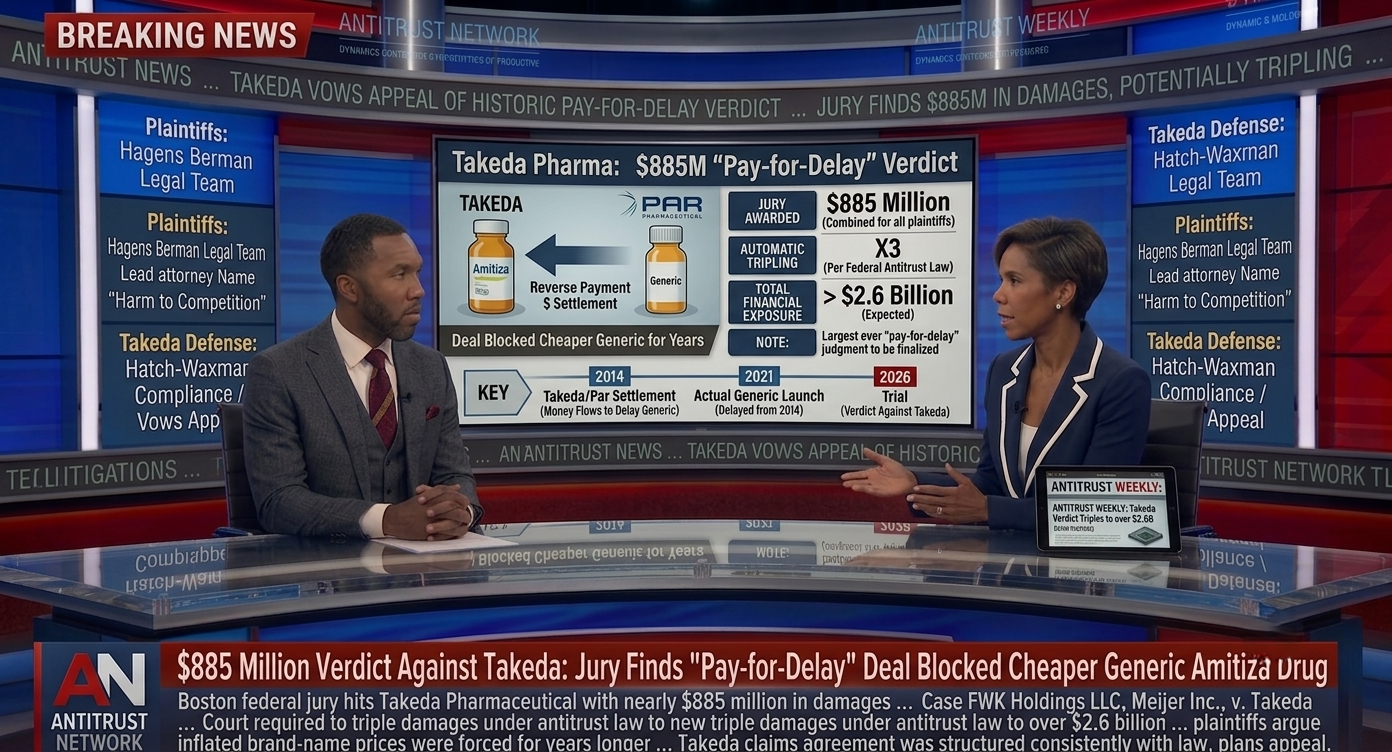
A federal jury has found Takeda Pharmaceutical liable for nearly $885 million in damages, ruling that the company illegally paid a generic drug manufacturer to delay a cheaper version of its constipation medication from reaching pharmacy shelves. Because of how federal antitrust law works, that number is set to grow dramatically before this case is finally over — potentially exceeding $2.6 billion.
The Verdict, By the Numbers
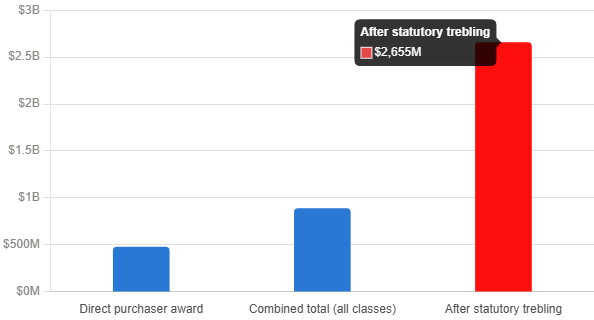
- $474.89 million — the damages awarded specifically to the class of direct purchasers of the drug (pharmacies and wholesalers), before any legal multiplier is applied
- Nearly $885 million — the combined damages total once separate awards to two additional plaintiff groups, an “end payer” class and a retailer class, are added in
- Automatically tripled — under federal antitrust law, courts are required to triple whatever damages a jury awards, as a deterrent against anticompetitive conduct
- Over $2.6 billion — Takeda’s likely total financial exposure once the tripling is formally applied at final judgment
- ~$1 billion — how much money Takeda and its partner reportedly made selling the brand-name drug in the years following the disputed settlement, according to the plaintiffs’ attorneys
- 5 weeks — the length of the trial, which began April 13, 2026, and ended with a verdict on May 18, 2026
The Drug at the Center of the Case
The case revolves around Amitiza, a twice-daily capsule used to treat chronic constipation and irritable bowel syndrome, originally developed by Sucampo Pharmaceuticals. Back in 2004, ahead of the drug’s 2006 FDA approval, Sucampo and Takeda struck a deal to jointly develop and sell the medication together. Notably, Takeda has since moved on entirely — the company ended its partnership with Sucampo in 2024 and no longer sells Amitiza at all.
What “Pay-for-Delay” Actually Means
Here’s the arrangement that got Takeda in trouble. Back in the mid-2010s, generic drug manufacturer Par Pharmaceutical filed a legal challenge against Amitiza’s patents, arguing it should be allowed to bring a cheaper generic version to market. Rather than fighting that challenge to the finish, Takeda settled with Par in the fall of 2014 — and as part of that settlement, Takeda paid Par money, while Par agreed to hold off launching its generic for years.
This kind of arrangement is known in the industry as a “reverse payment,” since money flows backward — from the original brand-name company to the generic competitor — instead of the more typical direction. Critics have nicknamed the practice “pay-for-delay,” since the entire purpose is to postpone cheaper competition from reaching the market. The U.S. Supreme Court has previously ruled that sufficiently large, unjustified reverse payments like this can violate federal antitrust law.
The Plaintiffs’ Case
According to the lawsuit, pharmacies and wholesalers who purchased Amitiza argued they were forced to pay inflated, brand-name prices for years longer than they should have, specifically because Takeda’s settlement kept the cheaper generic version off the market. The plaintiffs pointed to Amitiza’s core ingredient patent — covering the active compound lubiprostone — which had actually already expired back in 2014. They argued the additional patents Takeda leaned on to justify the delay were, in the words of the original complaint, “weak, easily-designed around patents standing in the way of generic market entry.”
The plaintiffs’ lead trial attorney, Thomas M. Sobol of law firm Hagens Berman, led a legal team that spent five weeks walking the jury through highly technical testimony covering patent law, FDA regulatory processes, and pharmaceutical economics. Attorney Kristen Johnson, part of that same legal team, summed up the jury’s takeaway after the verdict came in:
They fundamentally understood that paying a competitor to stay out of the market harms competition.”
Takeda’s Defense
Takeda has pushed back hard on the idea that its settlement was improper. The company has pointed out that the deal actually allowed Par to launch its generic version in 2021 — which, by Takeda’s own account, was still six years before Amitiza’s original patents were set to fully expire, and about 17 months before Par’s own generic drug application had even received FDA approval. Takeda also noted that other generic competitors entered the market on their own separately licensed timelines, arguing this wasn’t some blanket effort to block all competition.
The company maintains its agreement was structured consistently with the Hatch-Waxman Act, the 1984 federal law that created the modern framework for how generic drugs reach the U.S. market in the first place.
Following the verdict, Takeda released a statement expressing clear disagreement with the outcome, saying the trial involved unspecified “evidentiary and legal errors.” The company added:
“We remain firm in our conviction that the plaintiffs’ case lacks merit.”
Takeda has confirmed it plans to pursue both post-trial motions and a formal appeal.

Where the Case Stands Now
The case, formally titled FWK Holdings LLC, Meijer Inc., and Meijer Distribution v. Takeda Pharmaceutical Company Limited, was heard in federal court in Boston, Massachusetts, and also names Takeda Pharmaceuticals U.S.A. Inc., Endo International plc, and Par Pharmaceutical, Inc. as defendants.
While the jury’s roughly $885 million verdict is already one of the larger pay-for-delay judgments in recent memory, it’s genuinely just the starting number. Antitrust damages in cases like this are automatically tripled by law once a court enters final judgment — meaning Takeda’s actual bill, barring a successful appeal, is expected to land somewhere north of $2.6 billion.
The Bottom Line
A jury spent five weeks working through dense legal and scientific testimony and reached a conclusion that’s fairly simple to state plainly: paying a rival to stay out of the market isn’t a clever business strategy, it’s against the law — and it comes with consequences that grow far larger than the original settlement ever cost. With Takeda now vowing an appeal, this case is far from over, but for now, the jury’s math points toward one of the most expensive pay-for-delay verdicts on record.
Sources referenced:
MedCity News – “Takeda Vows Appeal of $885M Jury Verdict in ‘Pay-for-Delay’ Antitrust Case”
Hagens Berman – “Attorneys at Hagens Berman Announce $474M Win in Amitiza Jury Trial Against Takeda”
Fierce Pharma – “Takeda slapped with $885M verdict in pay-for-delay antitrust case”
Yahoo News – “Takeda engaged in antitrust scheme to delay generic constipation drug, US jury finds”