


Imagine going to the doctor, having a completely routine visit, and then finding out months later that someone quietly added a diagnosis to your chart that was never actually discussed. That’s essentially what federal investigators say happened to patients across two states — and now it’s costing one of the country’s biggest healthcare companies over half a billion dollars.
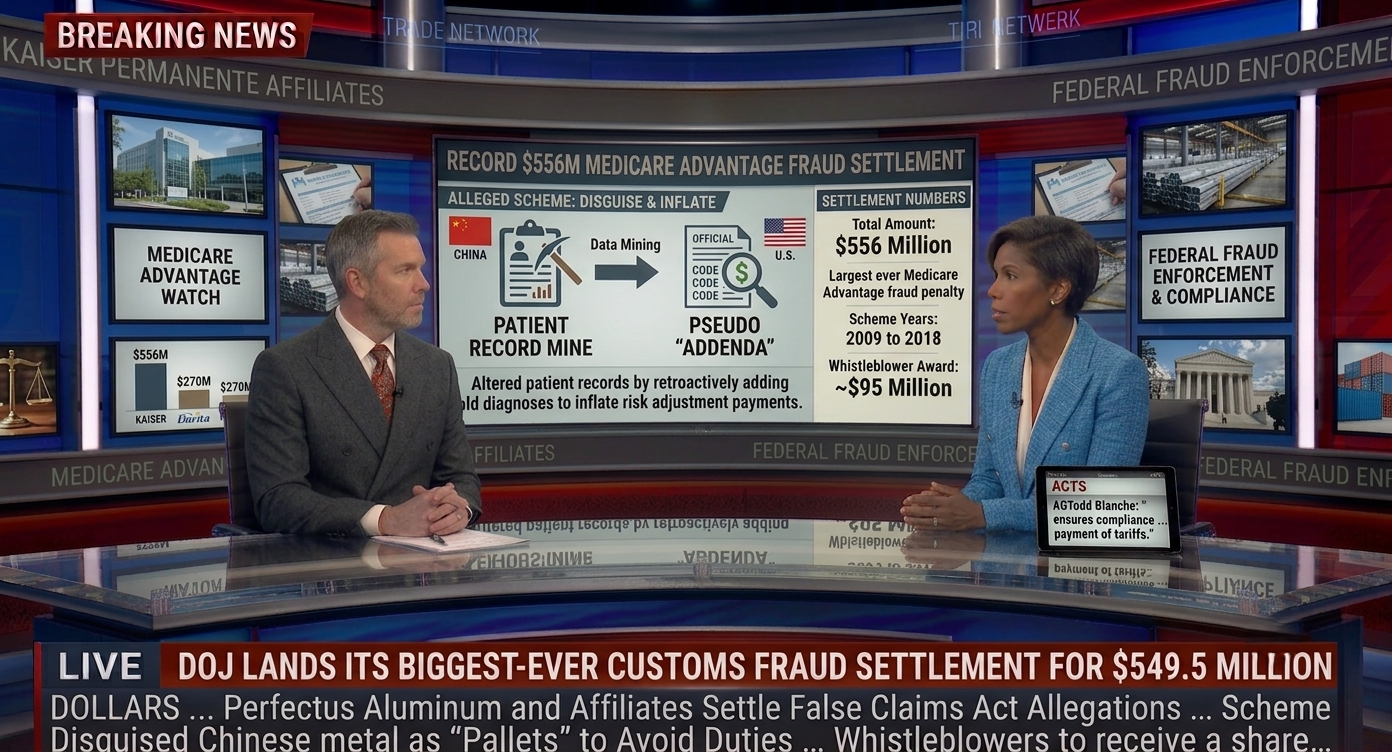
Kaiser Permanente affiliates have agreed to pay $556 million to resolve allegations that they violated the False Claims Act by pressuring doctors to add diagnoses to patient records long after visits had already happened, specifically to collect bigger payments from Medicare Advantage. It’s now the largest Medicare Advantage fraud settlement in U.S. history.

The Settlement, By the Numbers
- $556 million — the total amount Kaiser Permanente affiliates agreed to pay
- $95 million — the combined share going to the two whistleblowers who originally exposed the scheme
- 2009 to 2018 — the roughly nine-year period the alleged scheme is said to have run
- 5 Kaiser entities — the specific affiliates named in the settlement, spanning both California and Colorado operations
- ~2 million — the approximate number of patients enrolled in Kaiser’s Medicare Advantage plans
- 6% — Kaiser’s share of the overall Medicare Advantage market, making it a comparatively small player compared to giants like UnitedHealth — yet still the target of the largest settlement of its kind to date
How Medicare Advantage Payments Actually Work
To understand the alleged scheme, it helps to understand the underlying payment system. Under Medicare Advantage, also called Medicare Part C, seniors can opt out of traditional Medicare and enroll in private health plans instead. The federal government pays those private insurers a fixed monthly amount for each patient — but adjusts that amount up or down based on how sick a patient is expected to be. Sicker patients mean higher expected costs, so insurers get paid more for them; healthier patients mean less.
To calculate these “risk adjustments,” the government relies on diagnosis codes that insurers submit, which are supposed to come directly from documented, face-to-face visits between a patient and their doctor.
What Kaiser Allegedly Did Instead
According to the Justice Department, Kaiser didn’t just rely on doctors’ notes from actual visits. Investigators allege the company built systems specifically to mine patients’ past medical histories, looking for old diagnoses that had never been formally submitted for that year’s risk adjustment payments.
Kaiser then allegedly sent “queries” to its own physicians, pushing them to add these diagnoses to patient charts through addenda — official-looking additions to medical records — often months later, and in some cases, over a year after the original visit had already happened. The problem, according to investigators: many of these added diagnoses had nothing to do with what was actually discussed or treated during that visit in the first place.
The Pressure Campaign Behind the Scheme
This wasn’t framed as a one-off mistake or a few rogue employees. The government’s allegations describe a systematic push: Kaiser reportedly set aggressive, specific goals for individual physicians and facilities around how many risk-adjustment diagnoses they needed to add. Underperforming doctors and facilities were allegedly singled out, with messaging that made clear failing to hit these diagnosis-adding targets would cost money — for Kaiser, for the facility, and for the physicians themselves.
Making it more concerning, the government alleges Kaiser tied financial bonuses directly to how well physicians and facilities met these diagnosis-coding goals, effectively creating a direct financial incentive to keep adding diagnoses regardless of whether they reflected what actually happened during a patient visit.
Kaiser Reportedly Ignored Its Own Warning Signs
Perhaps the most damaging allegation in the whole case: prosecutors say Kaiser knew this was a problem and kept going anyway. According to the complaint, Kaiser’s own physicians raised concerns internally that these practices amounted to false claims, and Kaiser’s own internal compliance office conducted audits that specifically flagged the issue of inappropriate addenda being added to records.
The government alleges Kaiser had every opportunity to course-correct and simply didn’t.
Who Blew the Whistle
This case traces back to two former Kaiser employees who filed suit under the False Claims Act’s whistleblower, or qui tam, provisions: Ronda Osinek, who had trained physicians on medical coding guidelines and originally filed her case back in August 2013, and Dr. James M. Taylor, a physician who filed a related case years later, in 2021.
Under whistleblower rules, private individuals who expose fraud against the government are entitled to a percentage of whatever gets recovered. In this case, Osinek and Taylor are set to split a combined $95 million for bringing the underlying claims to light.
What Federal Officials Had to Say
Multiple government agencies weighed in after the settlement was announced, framing it as a serious message to the healthcare industry. Assistant Attorney General Brett A. Shumate of the DOJ’s Civil Division emphasized that with more than half the country’s Medicare beneficiaries now enrolled in Medicare Advantage plans, the government expects truthful reporting from every participant in the system.
U.S. Attorney Craig H. Missakian, for the Northern District of California, put it bluntly, framing Medicare Advantage as a program meant to:
“serve patients’ needs, not corporate profits.”
FBI San Francisco Field Office Special Agent in Charge Sanjay Virmani echoed that sentiment, noting the settlement reflects the FBI’s continued focus on holding accountable those who put profits over patients in federal healthcare programs.
How This Compares to Other Medicare Advantage Fraud Cases
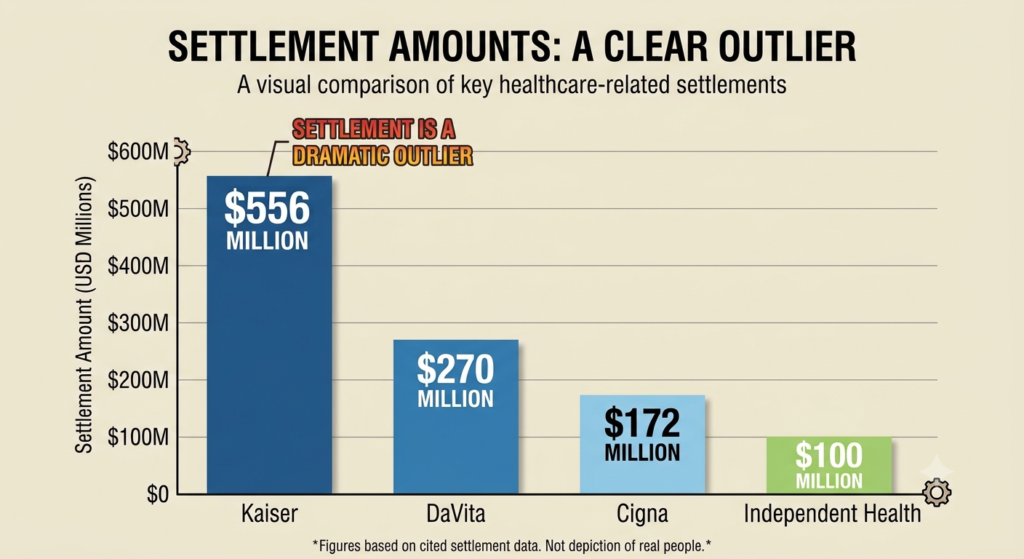
Kaiser’s $556 million settlement isn’t happening in isolation — it’s the latest and largest in a growing string of Medicare Advantage fraud cases. Previous notable settlements include DaVita, which paid $270 million in 2018 over similar inaccurate-diagnosis allegations, Cigna, which paid $172 million in 2023, and Independent Health, which agreed to pay up to $100 million more recently. Kaiser’s number eclipses all of them.
The timing is also notable: this settlement landed just weeks after a U.S. Senate report, led by Senator Chuck Grassley, separately accused a different major insurer, UnitedHealth Group, of “gaming” the same Medicare Advantage risk adjustment system — suggesting this kind of scrutiny is intensifying industry-wide, not just at Kaiser.
An Interesting Postscript: Kaiser vs. Its Own Insurers
In an ironic twist reported after the settlement, Kaiser reportedly turned around and sued a group of its own liability insurers, seeking to recover a portion of the settlement cost through insurance coverage. According to reporting on the dispute, those insurers pushed back using what’s been described as an “uninsurability defense” — arguing that since the settlement amounts to returning money Kaiser was never entitled to keep in the first place, it doesn’t count as a genuine, insurable business loss.
The Bottom Line
A healthcare giant covering millions of patients has agreed to pay the largest Medicare Advantage fraud settlement on record, following allegations that it turned old, unrelated medical history into fresh diagnoses months or years after the fact, specifically to collect bigger government checks. With federal officials signaling this is part of a broader crackdown across the entire Medicare Advantage industry, Kaiser’s record-breaking number may not stay the largest for very long.
Sources referenced:
Constantine Cannon – “Kaiser Pays Record $556M to Settle Medicare Advantage False Claims Act Case”