


A new legal playbook just got its first real-world test case, and it happens to involve one of the most recognizable names in American tech.
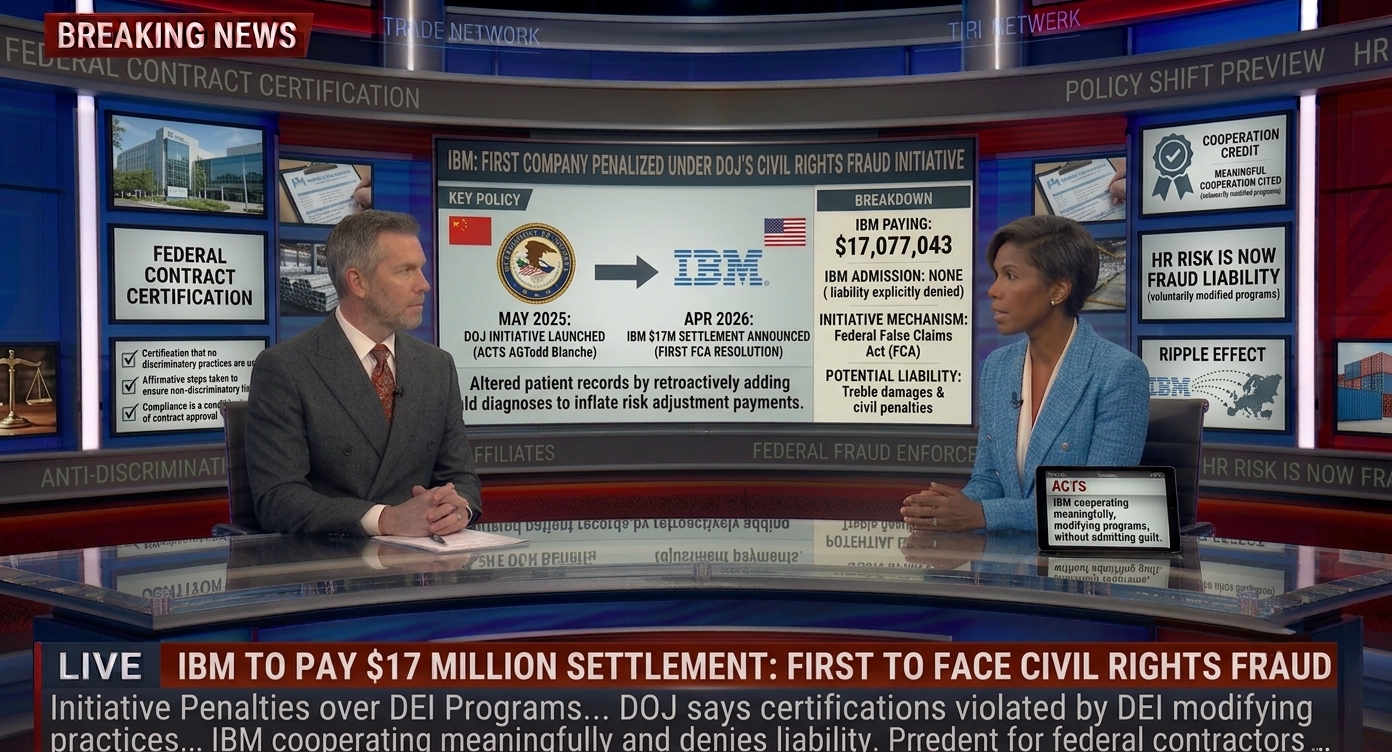
IBM has agreed to pay the U.S. government $17,077,043 to resolve allegations that its diversity, equity, and inclusion (DEI) programs violated anti-discrimination requirements built into its federal contracts. It’s the very first settlement reached under the Justice Department’s Civil Rights Fraud Initiative, a newly created enforcement effort — meaning this case is being closely watched as a preview of what’s coming for other federal contractors.

The Settlement, By the Numbers
- $17,077,043 — the exact amount IBM agreed to pay, inclusive of civil penalties
- 1st — this is the first False Claims Act resolution secured under the Civil Rights Fraud Initiative since it was created
- May 2025 — when Acting Attorney General Todd Blanche originally launched the Civil Rights Fraud Initiative
- April 10, 2026 — the date the settlement was formally announced
- 0 — the number of admissions of wrongdoing IBM made; the settlement explicitly states the underlying allegations were never proven and IBM denies liability
What Federal Contracts Actually Require
To understand this case, it helps to know how federal contracting works. Most contracts between companies and the U.S. government include standard provisions requiring the contractor to certify it won’t discriminate against employees or job applicants based on race, color, national origin, or sex — and that it will actively ensure hiring and workplace treatment happen without regard to those characteristics. Companies sign these certifications as a basic condition of doing business with the federal government.
The government’s allegation in this case was that IBM’s certifications didn’t match its actual internal practices.
What the Government Specifically Alleged
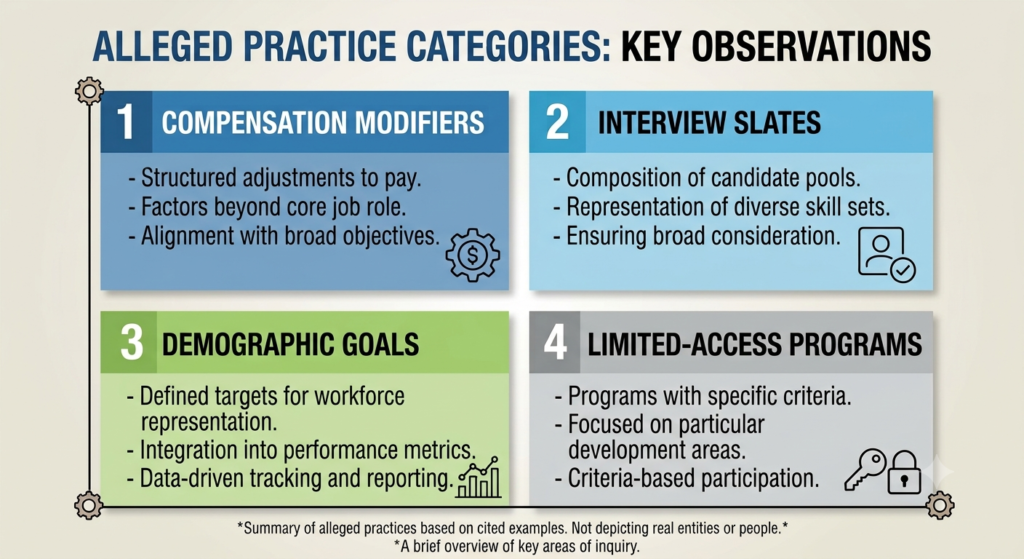
According to the Justice Department, the allegations against IBM centered on several distinct practices:
- Using a “diversity modifier” that tied part of employees’ bonus compensation to whether the company hit specific demographic targets
- Using “diverse interview slates” — altering standard interview criteria specifically to surface candidates of a particular race or sex for hiring, transfers, or promotions
- Setting race and sex-based demographic goals for individual business units, and then factoring race or sex into employment decisions to help meet those goals
- Limiting access to certain training programs, mentoring, leadership development programs, and partnership opportunities to employees of specific races or sexes only
Importantly, these are allegations laid out by the government as part of a negotiated settlement — not findings from a trial or court ruling, and IBM has not admitted to any of them.
Why This Case Exists: The Policy Behind It
This settlement doesn’t exist in a vacuum — it’s a direct result of a broader federal policy shift. In January 2025, shortly after taking office, President Trump signed an executive order titled “Ending Illegal Discrimination and Restoring Merit-Based Opportunity,” directing federal agencies to scrutinize and eliminate DEI practices the administration considers unlawful. A follow-up executive order in March 2026 went further, requiring federal contractors to formally certify they aren’t engaging in what the order characterized as discriminatory DEI activities.
The Civil Rights Fraud Initiative, launched by the DOJ in May 2025, was created specifically to give the government a legal mechanism — the federal False Claims Act — to pursue companies whose actual employment practices, in the government’s view, contradict the anti-discrimination certifications they’ve signed as federal contractors.
What Officials Said
Acting Attorney General Todd Blanche framed the settlement as a direct enforcement message to other federal contractors, stating:
“Racial discrimination is illegal, and government contractors cannot evade the law by repackaging it as DEI.”
Associate Attorney General Stanley Woodward echoed a similar message, emphasizing a merit-based standard:
“Merit drives promotion and opportunity. Not someone’s sex or race.”
Deputy Assistant Attorney General Brenna E. Jenny framed the case around the specific conditions companies accept when they take federal funding, noting that when a company sorts or disadvantages employees based on race or sex, it steps outside the terms the government agreed to when contracting with it.
What IBM Had to Say
IBM did not admit wrongdoing as part of the settlement, and a company spokesperson made that position clear publicly, stating:
“IBM is pleased to have resolved this matter… our workforce strategy is driven by a single principle: having the right people.”
The Justice Department’s own settlement announcement also acknowledged that IBM cooperated meaningfully during the investigation — making early disclosures from its own internal review, providing information that helped the government calculate potential damages, and voluntarily ending or modifying the specific programs and practices the investigation had identified.

Why This Case Matters Beyond IBM
Legal analysts tracking federal contracting have flagged this settlement as a genuinely significant shift, not just a single company’s issue. Because it’s the first resolution under this specific initiative, attorneys who advise government contractors are treating it as a template for how the DOJ plans to evaluate similar DEI-related practices at other companies going forward.
One particularly notable legal wrinkle: this case uses the federal False Claims Act, a law dating back to the Civil War era, that allows the government to pursue treble damages (three times the actual harm) plus additional penalties, and even allows private whistleblowers to file their own suits and share in any recovery. Legal commentators have pointed out that applying this law to DEI-related employment practices is new territory, turning what has historically been treated as an HR or reputational risk into a potential federal fraud liability for any company holding government contracts.
Reporting following the settlement has also noted that IBM isn’t the only major company that has faced DEI-related federal scrutiny recently, suggesting this case may be the first of several similar actions rather than an isolated event.
The Bottom Line
This settlement represents a genuinely new use of an old law, and both sides have been clear about how they’re framing it. The government describes it as accountability for contractors who don’t live up to anti-discrimination certifications they’ve signed. IBM describes it as a resolved matter it agreed to close out, without admitting the underlying allegations were true. Whatever your view of the underlying DEI policy debate, the practical takeaway for federal contractors is straightforward: this is now an active enforcement area, and IBM’s $17 million settlement is likely just the opening chapter.
Sources referenced:
Latham & Watkins LLP – “IBM Pays $17 Million in First DEI-Related False Claims Act Resolution”